An arsenal for strategy
Why skills matter in strategy work, what one consulting skill library holds, and why choosing the tool stays with the strategist
A second brain for strategy gave my strategic thinking a memory. This paper is about the tools I used on it. Installing one consulting skill library gave me 21 plays and 138 reference modules in one command, more methods than I could hold in my head. What it did not give me was the judgement of when to use each one. I kept the library locked until I called it, set aside the consultant persona that came with it, and took out only the plays that test my own thinking: the problem frame, the issue tree, the assumption audit, the case for the strongest alternative and the war-game. In one practice run, building the case for the strongest alternative changed my thesis, and the rival answer became its spine. Writing two skills of my own showed me where the effort sits. The file itself is quick. Knowing the method well enough to write it down, and testing it until it holds, takes much longer. I want to keep going: adapt this arsenal to my own way of working, and build one of my own for technology strategy. The tools are borrowed and credited. The fort is mine.
Written during my Executive MBA, October 2026. The companion to A second brain for strategy.
Abstract
Skills are now a common way to give an AI agent a method: a folder with a short label, a set of steps and the reference material behind them, opened only when the work needs it. This matters for strategy, which is built from many different jobs, each with its own method. This paper explains skills through the image of a fortmaker and an armoury. The strategist is the fortmaker, who chooses a tool for each section of the fort and builds the keep alone. The arsenal examined is an open-source management consultant skill library: 21 plays, 138 reference modules and 16 worked cases, of which the agent carries 92 words until a tool is called. The paper maps what the arsenal holds and sets out seven advantages for a strategist. Skills are widely available, so the one barrier left is AI literacy. Writing a skill takes an hour, a tested one about a day, and a library months. The next step is to adapt the arsenal and build one for technology strategy.
Keywords: skills, strategy tools, AI literacy, management consulting, technology strategy
B.1 Why strategy work needs an arsenal
A strategy is not made in one move. It is built from a sequence of different jobs: framing the question, breaking it into parts that do not overlap, mapping the market and the rivals, generating real options, testing the assumptions the choice rests on, playing the plan against a rival, and checking who must support it. Each job has a method, and each method has its steps, its traps and a standard for good work. Few strategists hold all of them in their head at once, and fewer apply them the same way every time.
Research on strategy practice finds that what a tool achieves depends on how the strategist picks it up and uses it (Jarzabkowski and Kaplan, 2015). The old warning makes the same point from the other side: with only a hammer, everything looks like a nail (Maslow, 1966). A strategist needs many tools within reach, and the judgement to pick the one that fits.
Skills give an AI agent that arsenal. A skill packages a method as a folder the agent opens when the work calls for it (Anthropic, 2025a). Skills are already widely used. The format became an open standard in December 2025, agent products ship with skills of their own, and the library examined here has been starred 136 times and copied 24 times on GitHub (DogInfantry, 2026). This paper makes the case for skills in strategy work, with one condition: the strategist chooses the tool.
B.2 The fortmaker and the armoury
Think of a strategy as a fort. It has to stand on firm ground, keep out what it was built to keep out, and survive a siege. A fortmaker does not build it with one tool. They survey the ground, lay a foundation, raise walls with no gaps, place a gate, post a watch, and test the walls before an attacker does. Each job needs a different tool, and the fortmaker’s skill is knowing which one to take from the armoury next.
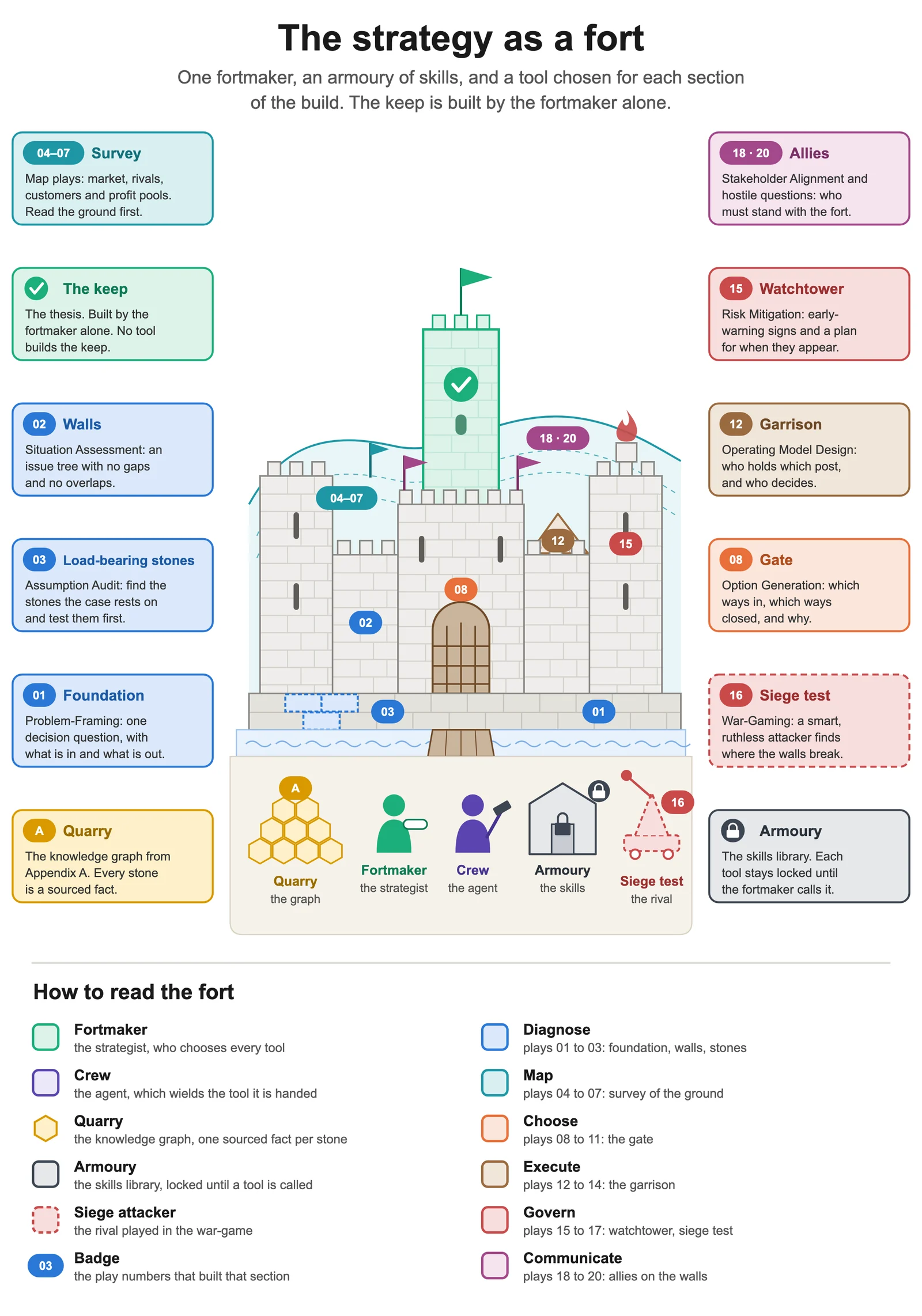
Figure B.1. The strategy as a fort. Each section is built with a tool the fortmaker chose for it, and the badges give the plays that built it. The keep is built by the fortmaker alone.
Figure B.1 maps skills onto the fort, and Table B.1 sets out the analogy term by term. Two features matter more than the rest. The armoury is locked: a tool comes out only when the fortmaker asks for it. And the keep, the thesis at the centre, is built by the fortmaker alone. No tool builds the keep, because the verdict is the strategist’s.
Table B.1. The analogy, term by term.
| In the fort | In AI-assisted strategy work | Why it matters |
|---|---|---|
| Fortmaker | The strategist | Chooses the ground, the tool for each section and the verdict |
| Armoury | The skills library | Holds every tool, locked until called by name |
| Tool | A skill, or one play inside it | A tested method with its steps and a quality bar |
| Tool’s manual | The skill’s instructions | Says when to reach for the tool and how to use it |
| Crew | The AI agent | Wields the tool it is handed, under the strategist’s rules |
| Stone from the quarry | Sourced facts from the knowledge graph in A second brain for strategy | Walls are built from evidence, not from invented figures |
| Plumb line | The play’s quality bar | The standard each section is held to |
| Siege test | War-gaming and hostile questions | Finds where the walls break before a rival does |
| The keep | The thesis | Built by the strategist alone |
B.3 What a skill is
A skill is a folder that holds one main instruction file, often with reference files and scripts beside it (Anthropic, 2025a). The file opens with a short label: a name and a description of what the skill is for and when to use it. Below the label sit the instructions. The reference files hold the depth. Skills usually arrive in a plugin, a bundle installed from a marketplace with one command (Anthropic, 2025b).
The design that matters to a strategist is progressive disclosure (Figure B.2, Table B.2). At rest the agent carries only each skill’s label. When a skill is called, it reads the instructions. It opens a reference file only when the instructions point to it and the task needs it. So an arsenal can be very large and still cost almost nothing to carry. The library examined here has a 92-word label, 7,141 words of instructions and about 453,000 words of reference, and at rest the agent carries about 0.02% of it.
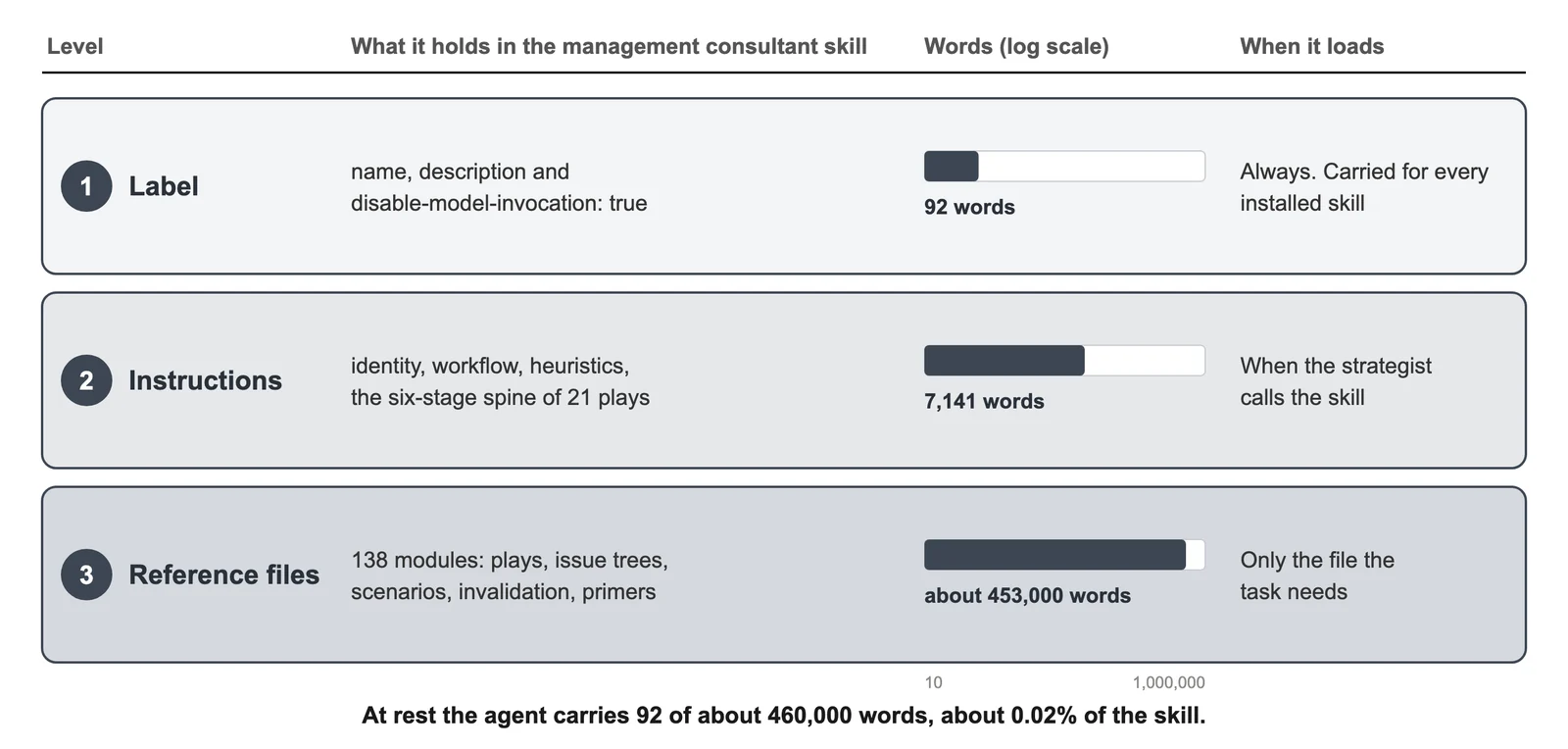
Figure B.2. Three levels of a skill, measured on the management consultant skill library, version 2.4.0. Only the label is carried until the tool is called.
Table B.2. The three levels of a skill and their place in the armoury.
| Level | What loads | When | In the armoury |
|---|---|---|---|
| Label | Name and description, 92 words here | At start, for every installed skill | The tag on the tool, which says what it is for |
| Instructions | The body of the main file, 7,141 words here | When the skill is called | The manual, read when the tool is taken out |
| Reference files | 138 modules, about 453,000 words here | Only the file the task needs | The attachment fetched for one job |
Four terms are easy to confuse (Table B.3). A framework is the idea. A skill is the idea packaged with the moment to use it, the steps to run it and a test of whether the result is good enough. That packaging is what turns a reference book into a tool.
Table B.3. Framework, prompt, skill and plugin.
| Term | What it is | Example | In the fort |
|---|---|---|---|
| Framework | A way of thinking about a problem | Five Forces, an issue tree | A technique, such as how to lay a course of stone |
| Prompt | A one-off instruction in a conversation | “Run a pre-mortem on this plan” | A spoken order, forgotten after the job |
| Skill | A reusable method with its label, steps, quality bar and references | A management consultant skill | A tool with its manual, kept in the armoury |
| Plugin | An installable bundle of skills and commands | A consulting plugin, pinned to a version | A crate of tools delivered to the armoury |
B.4 Inside the arsenal
Figure B.3 maps what the library holds, in four layers. The label is all the agent carries until the library is called. The instructions set out a way of thinking and three tests, a seven-step workflow, eleven heuristics, how to handle ambiguity, and a routing table that says when to open each module. The spine is a six-stage strategy cycle, from Diagnose to Communicate, carrying 21 plays, with a 21st play that runs the full cycle. Behind them sit 138 reference modules and 16 worked cases on mergers and governance failures.
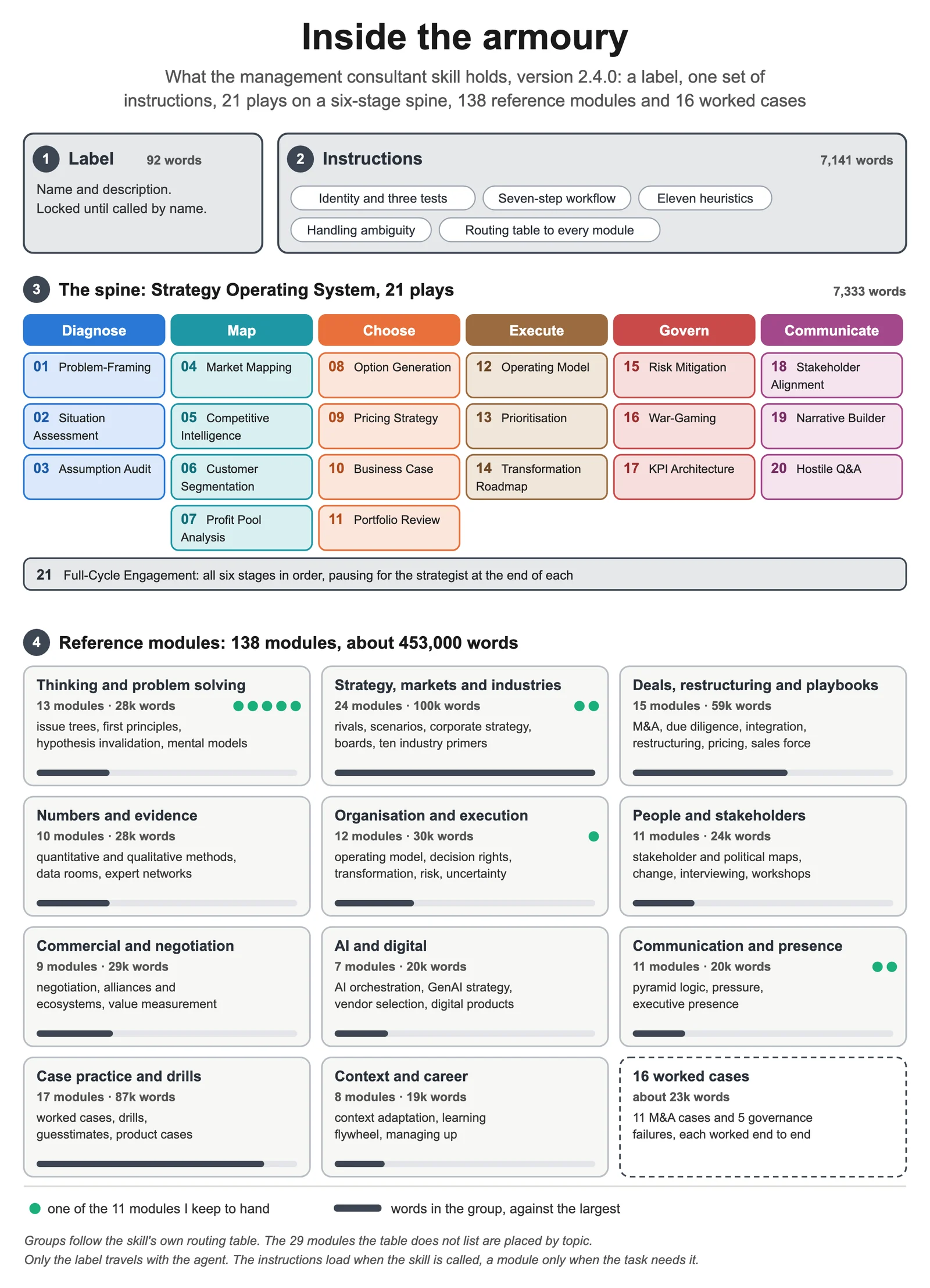
Figure B.3. Inside the armoury: what the management consultant skill library holds, measured on the installed files. Green dots mark the 11 modules I keep to hand.
Three things stand out in Figure B.3. The arsenal is broad: its two largest groups are strategy, markets and industries (24 modules) and case practice (17 modules), and it reaches from board governance to negotiation. It is deep where strategy work needs depth: the thinking group alone holds issue trees, first-principles thinking, mental models and a module on trying to prove a hypothesis wrong. And at any moment most of it is unused. Of 138 modules, I keep 11 to hand. The rest stay on the shelves until a question calls for them, which is how an armoury should work.
One setting in the label matters more than any other to a strategist. The library is marked so that the agent cannot take it out by itself. Only the strategist can call it. The tool stays in the armoury until the fortmaker asks for it.
B.5 The habits of mind the arsenal carries
Most of the arsenal is reference. A few ideas carry the habits of mind that make it useful, and a strategist can use them with or without an agent.
Three tests on every claim. What is the insight, not just the data? What evidence supports it? What should be done about it? The second test is the one the second brain’s graph is built to answer, since every figure must trace to a note.
Moves that work inside any framework. Start from the answer you would give today. Break any aggregate number into its parts. Ask what happens after the first move. Assume the plan failed and work back to why. Sort what is known from what can be found out and from what can never be known. These are not frameworks. They make every framework work harder.
The same anatomy in every play. Each play says when to reach for it, sets out its frame, lists what to produce, offers a move to push one level deeper, and ends with a quality bar. The quality bar is the plumb line. The best one sits on the assumption audit: the dangerous assumptions are usually the ones everyone is sure of and nobody has tested.
Tools that attack the strategist’s own position. The war-game plays the rival as smart and ruthless, to win and not to flatter. The pre-mortem assumes the thesis is wrong and asks what proved it. The steelman builds the full case for the answer the strategist does not hold. The assumption ladder tests the weakest link in the chain first. These are the tools that changed my thinking, because they look for what would make me wrong.
Judgement stays with the decision maker. The library says this of itself: its plays widen the options and test the logic, and the call belongs to the person who must make it. That principle is the one this paper is built on.
B.6 Seven advantages for the strategist
Packaging methods as skills gives a strategist seven advantages (Table B.4). Each has a meaning in the fort and a meaning in strategy work, and each can be seen in this arsenal.
Table B.4. Seven advantages of skills for strategy work.
| Advantage | In the fort | In strategy work | Evidence or example |
|---|---|---|---|
| Method on demand | The right tool is in the armoury when the section needs it | 21 plays and 138 modules a call away, each saying when to reach for it | Every play opens with when to reach for it |
| Depth without weight | The fortmaker carries one tool, not the armoury | Labels only until a tool is called, so a large arsenal costs little | 92 of about 460,000 words carried at rest. The right tool picked 13.6% of the time with every tool in view, 43.1% with the relevant few (Gan and Sun, 2025) |
| The same standard every time | Every course is held to the same plumb line | Steps and a quality bar make a method repeatable across questions and people | Each of the 21 plays ends with a quality bar |
| Expertise passed on | The master’s methods are in the manual, so apprentices build to the master’s standard | A senior consultant’s moves, written down and reusable | AI help lifted below-average consultants by 43% and above-average ones by 17% (Dell’Acqua et al., 2023) |
| Challenge built in | The siege test comes before the siege | Tools that try to prove the case wrong are part of the kit | Imagining a failure first raised the reasons people found by about 30% (Mitchell et al., 1989), the basis of the pre-mortem (Klein, 2007) |
| Shared and portable | One armoury serves every fort the company builds | An open format a team can share, pin to a version and copy | An open standard since December 2025 (Anthropic, 2025a). This library has 24 forks |
| Grows with the strategist | The fortmaker can forge new tools at the smithy | A skill is plain text, so it can be changed and extended | My own skill on this arsenal was built and tested in about a day (B.10) |
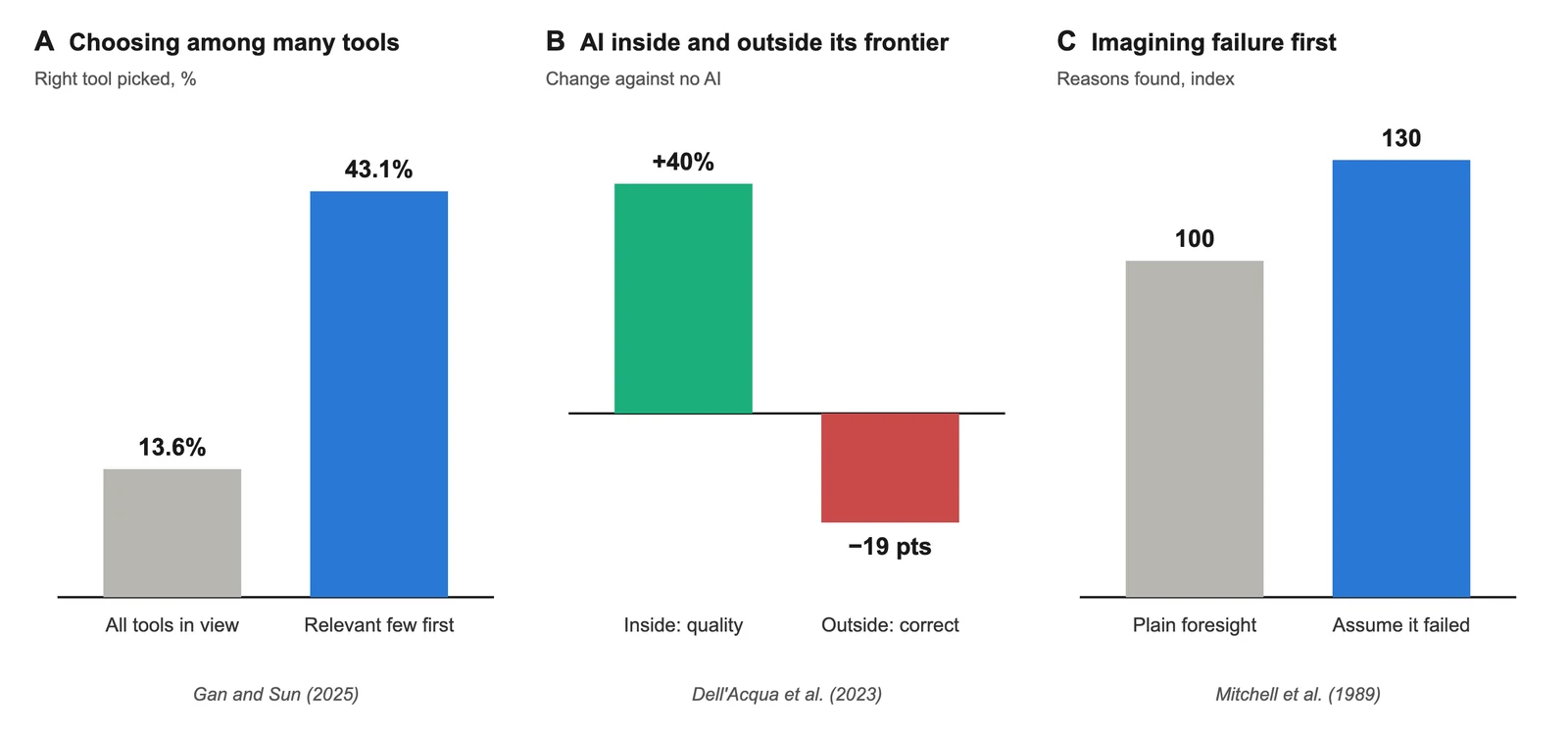
Figure B.4. Three results behind the advantages: tool choice with every tool in view against the relevant few (A), AI help inside and outside its frontier (B), and the reasons found when a failure is imagined as already having happened (C). Panel B mixes units, as labelled.
The advantages share one condition: a tool raises the standard of work only when it fits the job. In the same BCG experiment, consultants who used AI on a task outside its frontier were 19 percentage points less likely to reach the right answer (Dell’Acqua et al., 2023). Skills widen what a strategist can do. They do not decide which tool fits. That is the strategist’s job, and the subject of B.7.
B.7 Choosing the tool is the strategist’s job
The library offers its own routing: a first step that matches each brief to one of five demand archetypes, and a long table of when to open each module. Both route by the topic of the brief. A strategist routes by the situation: what kind of strategic problem this is, which section of the argument is weakest, and which tool tests that section. Good strategy work selects the right tools and uses them critically. The trap is filling in a framework. Routing by situation is how the first is done and the second avoided.
Table B.5 is my own map from situation type to tools. Every question starts with the three Diagnose plays. Each situation type then gets a first play, and a second only when time allows, each lined up with the classic strategy tool it works beside. The classic tool is the lens. The play is the move that works the lens harder.
Table B.5. The strategist’s map from situation type to tools.
| Situation type | First tool | Second tool | Classic tool it works beside |
|---|---|---|---|
| Decision | 08 Strategic Option Generation | 03 again, on the chosen option | The rationale underlying the choice |
| Sustainable advantage | 05 Competitive Intelligence | 16 War-Gaming | When resources can be a source of competitive advantage |
| Business model fit | 07 Profit Pool Analysis | 06 Customer Segmentation | Value chain analysis, business model consistency |
| Ecosystem position | 16 War-Gaming, with each key ecosystem player as an actor | 18 Stakeholder Alignment | Response and scenario analysis, interdependence risk |
| Industry shift or threat | 16 War-Gaming | 07 Profit Pool Analysis | Response and scenario analysis, industry structure and trends |
| Execution gap | 12 Operating Model Design, in part | 18 Stakeholder Alignment | Strategy execution maps, what determines buy-in |
| Change under uncertainty | Scenarios and signposts | 15 Risk Mitigation, one left-field risk | Response and scenario analysis |
| No type fits | 01 again, to reframe | The Diagnose plays only | The tools that fit almost any situation |
Each tool then runs through the same loop (Figure B.5). The strategist reads the ground, finds the weakest section and chooses one tool. The agent runs it and grounds every fact in the graph. The strategist holds the result to the play’s quality bar and decides what enters the fort.
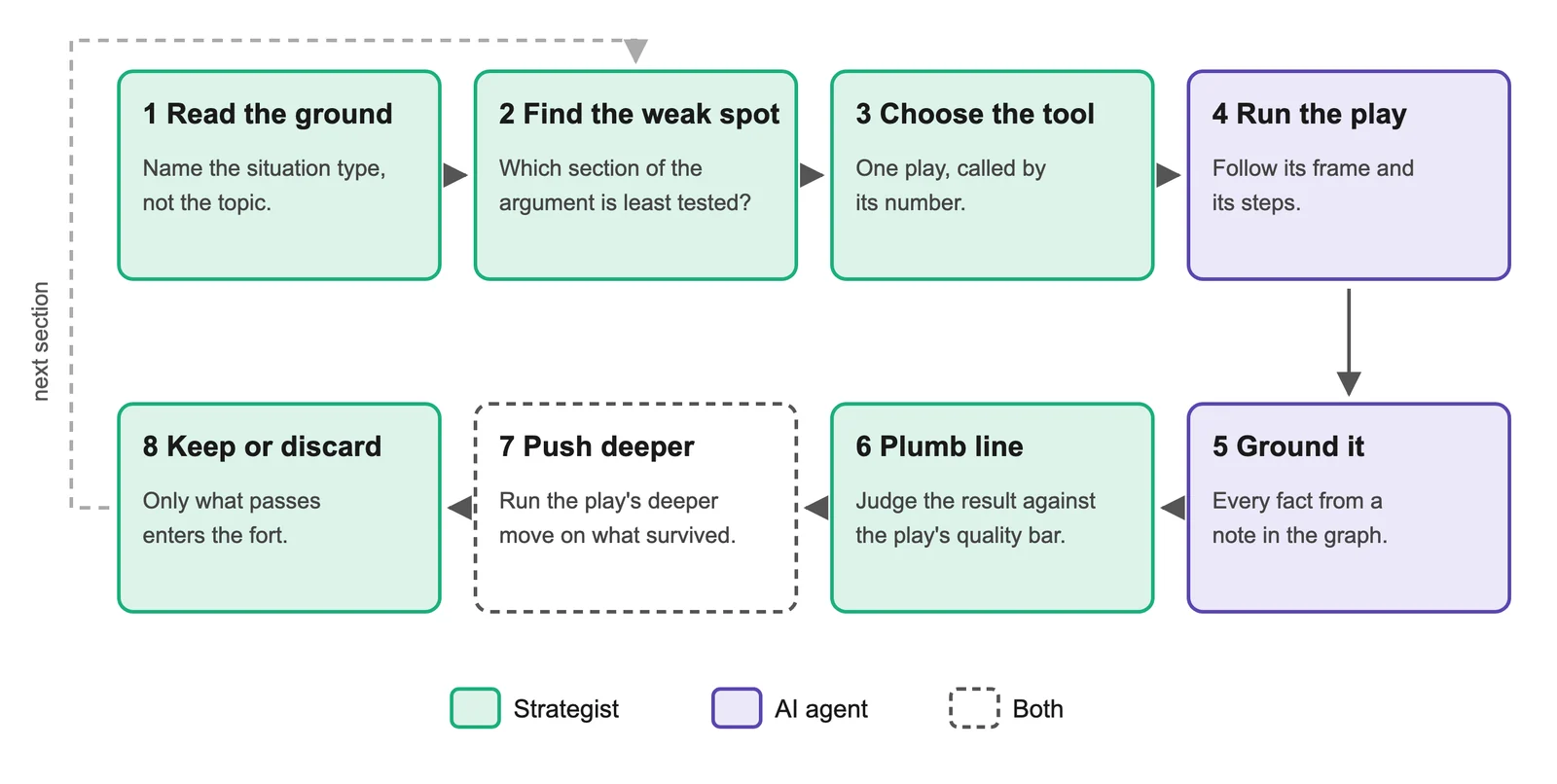
Figure B.5. The tool-choice loop. Green steps belong to the strategist, violet to the agent, dashed to both. The loop runs once per tool, and most questions need two or three.
Three habits keep the choice honest:
-
Name the tool. I call a play by its number, never “consult on this”, so the agent cannot drift across the whole arsenal.
-
Prefer tools that attack my own position. The assumption audit, the steelman and the war-game all look for what would make me wrong.
-
Stop at two or three. More tools give more output, not more insight. The third tool should test what the first two left standing.
Using the arsenal critically. I make three adjustments. The library gives the agent a senior consultant’s persona, and a confident voice can stand in for a tested claim, so I use the plays and leave the persona aside. The library asks the agent not to say where a practice case came from, which suits a firm’s casebooks but not the traceability the second brain depends on, so every figure I use comes from the graph with its source. And three of the five demand archetypes are about AI programmes, so I fix the situation type before choosing a tool, to stop a question about advantage turning into one about AI adoption.
B.8 One question, built section by section
Take an illustrative question: what should a mid-sized business base its competitive advantage on over the next three years? It is a sustainable advantage question, so Table B.5 gives the tools: the Diagnose plays, then 05 Competitive Intelligence and 16 War-Gaming, beside the classic tools on establishing and sustaining advantage.
Each section of the fort gets its own tool, and the strategist judges what each one returns.
-
Foundation, 01 Problem-Framing. The yes-or-no question “do we have an advantage?” becomes a race: can rivals copy what the business has built faster than it can extend it?
-
Walls, 02 Situation Assessment. An issue tree with two branches and nothing left out: rivals cannot copy it within three years, or they can.
-
Load-bearing stone, 03 Assumption Audit. The stone the whole case rests on is that the advantage is hard to copy. The audit asks what evidence says so, and how much weight that stone can take.
-
Survey, 05 Competitive Intelligence. Read the rivals: which of them has the money, the motive and the means to copy, and how fast they have moved before.
-
Siege test, 16 War-Gaming. Play the strongest rival to win. Its likely move is to copy the most visible part of the advantage. The exposed point is whatever can be lifted out in one piece.
No play built the keep. The thesis belongs to the strategist, and in this case it is that an advantage lasts when it is a system rather than any single part of it. In fort terms, a rival can take a tower but not the fort. Two tools stayed on the rack. Pricing would have pulled the question towards price, and Market Mapping would have sized a market the business already knows. Leaving them out was as much a choice as taking the others.
B.9 The one barrier is AI literacy
Skills are no longer hard to get. Installing this library took one command, the format is an open standard, and the agent I use ships with skills of its own for Word, Excel, PowerPoint and PDF files. Progressive disclosure keeps the cost of carrying them small. What remains is AI literacy: knowing what a skill is, what an arsenal holds and how to use it well. For a strategist that literacy has five parts:
-
Know the armoury. Know which skills exist and what each library holds, as Figure B.3 does for this one.
-
Read the label and the quality bar first. They say what the tool is for and what good looks like, before any steps are run.
-
Call a tool by name, at the right moment. The situation decides the tool, not the topic of the brief.
-
Judge the result against the evidence. A finished-looking result is not a tested one.
-
Read a skill’s files before trusting it. Skills carry instructions and sometimes scripts, so install them only from trusted sources (Anthropic, 2025a).
None of these is technical. Each is a habit, learnt by use, and I learnt them in the course of this build. That is why AI literacy, not access, is what separates strategists who get value from skills from those who do not.
B.10 What it takes to write a skill
Using a skill is quick. Writing one takes longer, and the time does not go where people expect. Figure B.6 sets out four levels of effort.
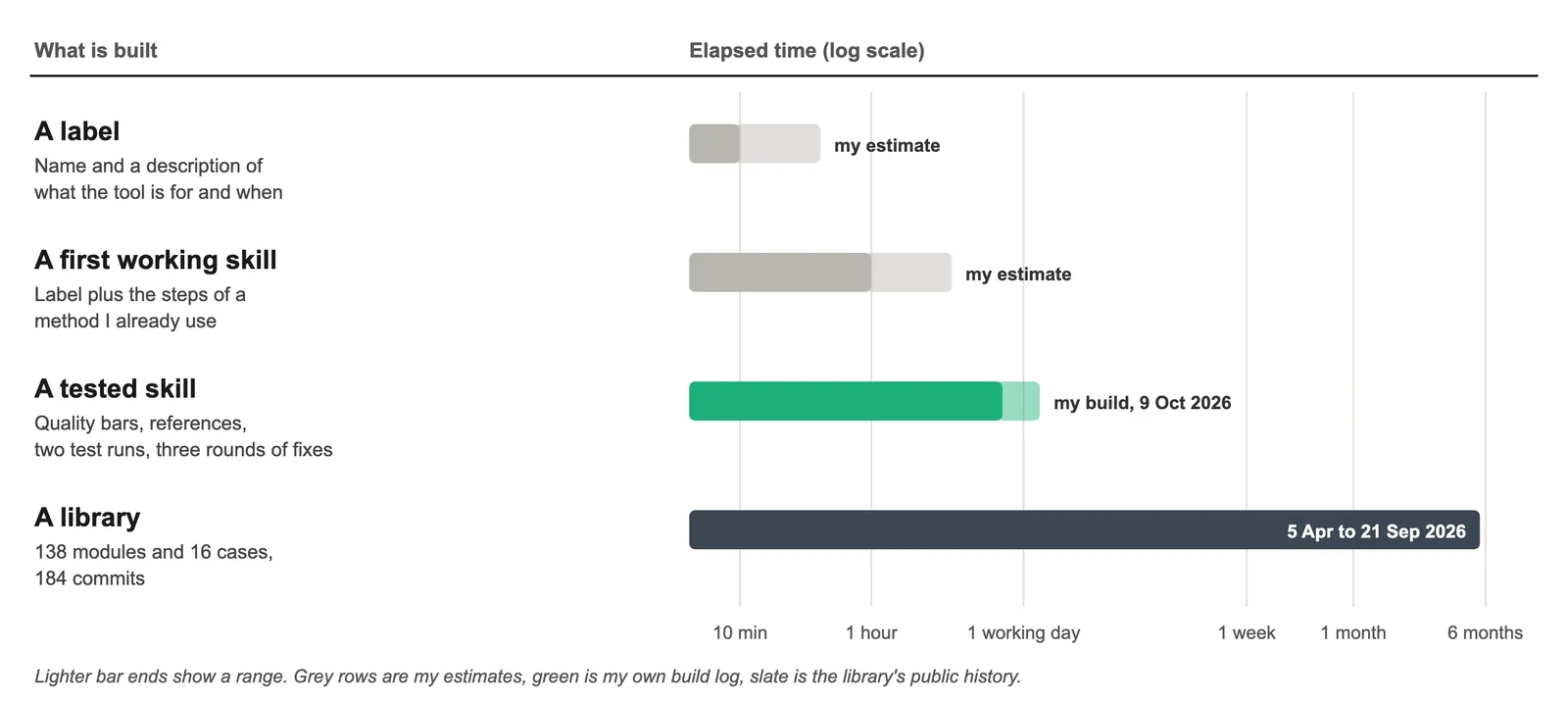
Figure B.6. Time to write a skill, at four levels. The top two rows are my estimates, the third is my own build, and the fourth is the library’s public history.
A label takes minutes, though it repays care, because the description is what the agent reads when it decides whether a skill applies. A first working skill, the label plus the steps of a method the writer already uses, takes an hour or two. Those two rows are my estimates. The third row is measured. On 9 October 2026 I built a skill of my own that routes each situation type to a first and a second play from this arsenal, the map in Table B.5. It took about a working day, from the first version in the morning to the last fix in the evening, with two full test runs and three rounds of fixes in between. A second skill was built in one evening and first tested the next morning. The fourth row is the library itself, which took its author about five and a half months, from first release on 5 April 2026 to 184 commits and 138 modules by 21 September 2026.
The time goes into the method and the testing, not the typing. Anthropic’s guidance says the same: write the tests before the instructions, keep the main file under 500 lines, and refine the skill by watching it used on real tasks (Anthropic, n.d.). This library’s main file sits at about that limit.
The effort is also why borrowing makes sense. Five and a half months of someone else’s work arrived in one command. A strategist’s own time is better spent choosing tools and adapting them than writing an arsenal from nothing.
B.11 Next: an arsenal of my own for technology strategy
This library is general. It covers every industry and every kind of consulting question, and much of it, such as interview drills and sector primers, sits outside the questions I work on. I want to make it more specific in two steps (Figure B.7).
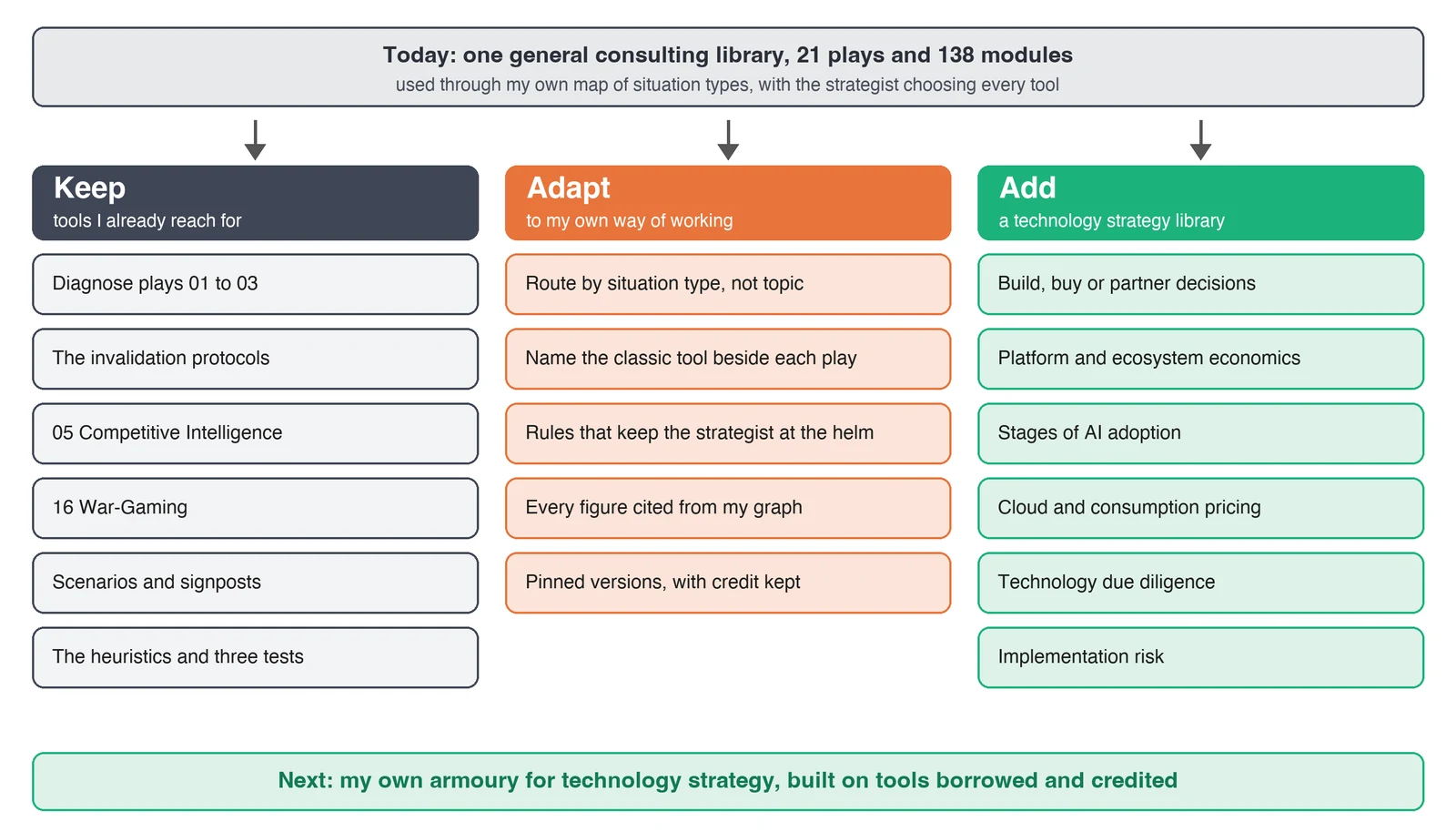
Figure B.7. From a borrowed armoury to my own. What I would keep, what I would adapt to my way of working, and what a technology strategy library would add.
The first step is to adapt this arsenal to my own way of working. I will keep the plays I already reach for and the protocols that try to prove a case wrong. I will adapt the rest so that it routes by situation type, names the classic strategy tool beside each play, cites every figure from my graph with its scope, and replaces the consultant persona with rules that keep the strategist at the helm.
The second step is an arsenal of my own for technology strategy. The modules I would add cover the questions technology strategy keeps raising: when to build, buy or partner, how platforms and ecosystems share value, where an organisation sits on the path to adopting AI, how cloud and consumption pricing change the economics, how to run technology due diligence, and how to judge implementation risk. Each module will have a label, a frame, a quality bar and its sources, and will be tested on real questions before it is trusted. The plays I borrow will keep their credit.
B.12 The fort stays the strategist’s
Skills put a consulting firm’s methods within reach of one strategist, at almost no cost to carry. That is a real advantage for strategy work, which is built from many different jobs, each with its own method. The arsenal examined here supplies 21 plays, 138 modules and 16 worked cases, and the agent carries 92 words of it until a tool is called. The one barrier left is AI literacy, and writing new tools takes time, most of it in testing. What skills do not supply is the choice of tool for each section of the work. That choice, and the keep at the centre, stay with the strategist.
Acknowledgement
The arsenal examined in this paper is claude-skill-management-consultant-B1 by DogInfantry, version 2.4.0, released under the Apache License 2.0: github.com/DogInfantry/claude-skill-management-consultant-B1. The tools are the author’s. Choosing them, using them and judging what they return is the strategist’s work, and so are any errors in doing so.
References
Anthropic (n.d.). Skill authoring best practices. Claude Developer Platform documentation, accessed 10 October 2026.
Anthropic (2025a). Equipping agents for the real world with Agent Skills. Anthropic Engineering, 16 October 2025, updated 18 December 2025.
Anthropic (2025b). Customize Claude Code with plugins. Anthropic, 9 October 2025.
Dell’Acqua, F., McFowland, E., Mollick, E., et al. (2023). Navigating the Jagged Technological Frontier: Field Experimental Evidence of the Effects of AI on Knowledge Worker Productivity and Quality. Harvard Business School Working Paper 24-013.
DogInfantry (2026). claude-skill-management-consultant-B1, version 2.4.0. Apache License 2.0. Repository history and counts accessed 10 October 2026. github.com/DogInfantry/claude-skill-management-consultant-B1
Gan, T. and Sun, Q. (2025). RAG-MCP: Mitigating Prompt Bloat in LLM Tool Selection via Retrieval-Augmented Generation. arXiv:2505.03275.
Jarzabkowski, P. and Kaplan, S. (2015). Strategy tools-in-use: A framework for understanding “technologies of rationality” in practice. Strategic Management Journal, 36(4), 537–558.
Klein, G. (2007). Performing a Project Premortem. Harvard Business Review, 85(9).
Maslow, A. H. (1966). The Psychology of Science: A Reconnaissance. Harper and Row.
Mitchell, D. J., Russo, J. E. and Pennington, N. (1989). Back to the future: Temporal perspective in the explanation of events. Journal of Behavioral Decision Making, 2(1), 25–38.
Tirukoti, M. (2026). A second brain for strategy. manojtirukoti.com, October 2026.
Got a live strategic question? Tell me about it.
Comments
(Comment with your GitHub account. I read every one and reply. Be kind and specific.)