Engineering Taste
How a human teaches a language model one person's sense of humour, why it never fully learns it, and why it still made me laugh
A bad joke has a teacher
LLMs are great at writing, but not great at humour. They can give a joke its shape, and even match an average joke, without understanding why it lands for one person. Humour is also a core human emotion, and everyone’s humour is different. When someone makes a bad joke, a few laugh and a few get offended, and we put it down to taste. When an AI makes a bad joke, we just call it bad AI, without asking who taught it what humour is, and how poorly they taught it.
This experiment is my attempt to teach an AI my kind of humour, which in the end means teaching it my taste. On the show, Him is raising his baby AI. Off the show, I was doing the same. It learnt the craft fast: open on a hook, make every line worse than the last, cut to the face, let the silence land. It never learnt my taste. Its own reviewer could not hear what it was judging, so it scored every reel it checked between 7 and 8 out of 10, including one where the voice spelt Mum as M-U-M.
Every refusal came from me, and so did the yes that made one reel the example for all the rest. And still, a few times, it made me laugh. I will keep teaching it, and keep writing down in my own words why a joke lands, so the next model starts from my taste and not from the average.
Written from the session logs of the engine behind my Instagram show, Me and My AI, October 2026.
Abstract
Taste is the ability to tell, without a complete rule and for a particular person, what is good and what is not. Large language models have no taste of their own. They are trained towards the likely, tuned towards the average rater, and judge their own work kindly. This paper asks how much of one person’s taste a human can engineer into an LLM agent without changing its weights, using the engine behind the Instagram show Me and My AI as the case. Over about 38 hours of elapsed time, of which the AI worked about 4.6 and I spent about 2.7, the engine wrote 53 reel scripts and finished 22 animated reels. Taste moved from me to the machine through five channels: selection, refusal, reference, rules and loops. The craft of a joke transferred well: the hook, the escalation, the cut to the listener’s face, the measured silence after the punch word. Judgement did not. When I stepped out, the agents’ editor, told to rewrite any script it scored below 8 out of 10, scored all 73 scripts it handled, remakes included, at 8 or above, and their reviewer gave 24 of its 31 scores as exactly 7 and none outside 7 to 8. My own verdicts over the same days ran from “very bad” to “perfect”. The third reel, the first made after the engine was built, took 22 minutes of my time against a conservative estimate of 15 hours by hand. The five times it delighted me each came after a correction, and four of the five were about delivery rather than words. The engine never matched my taste, but it made me laugh on a few.
Keywords: taste, aesthetic judgement, humour, large language models, preference learning, loop engineering, knowledge graph, human in the loop
Part I: What taste is
Beauty is no quality in things themselves: It exists merely in the mind which contemplates them.
David Hume, Of the Standard of Taste, 1757
1. Two reels, seven hours apart
On 31 October 2026, a little before two in the morning, an AI sent me a 78-second cartoon with a note: “I can’t hear audio, so please give it a listen.” I listened when I woke up. It was very bad. A little after nine, the same AI sent me a 46-second cartoon about whether pizza is healthy. I wrote back: “Yep this is perfect.”1
Nothing about the model changed between those two reels. No weights moved. What changed was what it had been taught. One more round of my refusals told it the pauses sounded wrong, so it rebuilt the voice to read each line in one take. The second reel was also built on real AI fails, which an earlier note of mine had asked for (Figure 1). This paper is about that teaching. Its subject is taste: what it is, how much of it a human can engineer into a language model, and where it stops.
The case is the engine behind Me and My AI, an Instagram show about Him, a smiling stick man, and My AI, his eager baby robot that is always sure and often wrong. An LLM agent writes the scripts, acts the voices, animates and renders the reels, and logs every step in an Obsidian vault. I bring the premise, the refusals and the final yes. Every measurement of the engine in this paper comes from the session logs, the vault and the run records, as at about 10.30 am on 31 October 2026, when a fourth change to the rules was rolling out.2 Two reels, the second and the third, went through all four of my gates, and a fourth stopped at the script. Reels 5 to 54 came from an autonomous batch, and a remake is a batch reel rebuilt under newer rules.
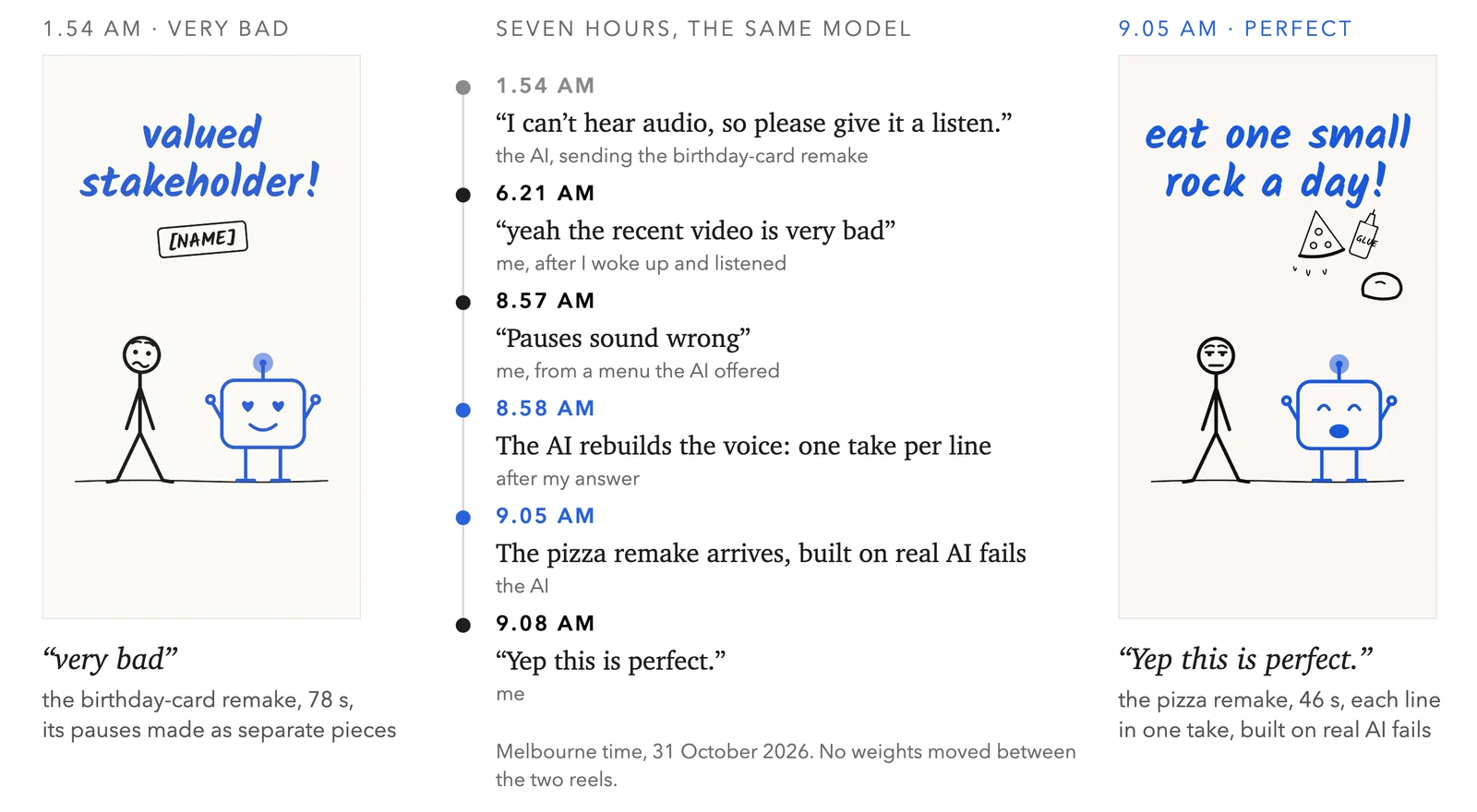
Figure 1. Two reels from the same model, seven hours apart, with everything said in between. Left: the birthday-card remake, which I called very bad. Right: the pizza remake, which I called perfect.
The paper has three parts. Part I defines taste and explains why a language model has none of its own. Part II shows how I engineered mine into the engine, through five channels. Part III tests what transferred, names what never can, and counts the times it made me laugh.
2. What taste is
Hume put the problem plainly in 1757. Beauty is not in the object but in the mind that looks at it, and each mind perceives a different beauty. Yet he would not let taste collapse into opinion. Some judges are better than others, and he named what makes them better: “Strong sense, united to delicate sentiment, improved by practice, perfected by comparison, and cleared of all prejudice”. His proof of delicacy is a joke. Two of Sancho’s kinsmen taste a cask of wine. One says it is good but for a small taste of leather, the other good but for a taste of iron. Everyone laughs at them. “But who laughed in the end?” When the cask is emptied, there is an old key on a leather thong at the bottom.3
Kant added the part that matters most for machines. A judgement of taste is felt, not reasoned from concepts, and yet it speaks as if everyone ought to agree. That is why no rule can settle it: there is no objective rule of taste that decides, by concepts, what is beautiful.4 Bourdieu added the social half. Taste sorts things, and in sorting them it sorts the one doing the sorting.5 A comedy account’s taste tells you who it is for.
Humour is taste at its most personal. Hume left room for it: one person is more pleased with the sublime, another with the tender, “a third with raillery”, and preferences like these “can never reasonably be the object of dispute, because there is no standard, by which they can be decided”. A sense of humour differs from person to person and stays fairly stable within one.6 When each of 10,000 texts was scored by twenty raters, the raters agreed well on whether a text was a joke (alpha 0.736), moderately on whether it offended (0.518), and barely on how funny it was (0.124) (Meaney et al., 2021). Benign violation theory explains the split. A thing is funny when it is a violation and benign at the same time, and whether it feels benign depends on how much the listener cares about the norm it breaks (McGraw and Warren, 2010). That would explain why, at the same joke, a few laugh and a few take offence.
Definition 1 · Taste. Taste is a person’s ability to tell, quickly and without a complete rule, which of two things is better for a purpose they care about, and to prefer it. It has three properties. It is personal: it belongs to one person or one audience. It is comparative: it is exercised by choosing between things. And it is perceptual: it starts with a sense, an ear or an eye, before it reaches a reason.
Definition 2 · Machine taste. A machine has taste for a person when it ranks things the way that person would. Machine taste is therefore not a quality of the model but a fit between a model and one person, and it can only be learnt from that person’s choices.
Definition 2 is old in computing. The Jester joke recommender of 1999 treated each user’s taste as a point in a small space learnt from their ratings, and named its algorithm Eigentaste (Goldberg et al., 2001). Modern reward models do the same with pairs: show two outputs, ask which is better, and fit a score that predicts the choice (Bradley and Terry, 1952, and Christiano et al., 2017). The question for this paper is what happens when there are tens of choices instead of thousands, and the weights cannot change.
3. Three layers of taste in a joke
A comedy reel asks for taste at three layers (Table 1). Selection decides what to make: which premise is worth forty-five seconds of a stranger’s attention. Shaping decides how to make it: the order of the beats, how much worse each line gets, where the pause falls, when to cut to the face. Verdict decides whether it worked: whether it is funny, for whom, whether it has crossed the line, and whether it is different from the last ten.
Table 1. Three layers of taste, how I taught each one, and what the engine learnt.
| Layer | What it decides | How I taught it | What the engine learnt |
|---|---|---|---|
| Selection | Which premise is worth making | I typed every premise in the gated reels, and approved a list of fifty in one line for the autonomous run | Partly. A bank of real AI fails and seven hook templates narrowed its choices, but the one premise it invented alone was rejected |
| Shaping | The beats, the escalation, the pause, the cut, the cover | Refusals, examples, research I asked for, and rules in the knowledge graph | Mostly. Rules with a number in them transferred, and most held |
| Verdict | Whether it is funny, for whom, near the line, new | Approvals at four gates, and lessons in my own words | Not at all. Its scores barely moved, and it could neither hear a reel nor see a pattern across reels |
4. Why a model has no taste of its own
A model arrives with the opposite of a beginner’s problem. Ira Glass describes beginners whose taste runs ahead of their ability, so their own work disappoints them for years.7 An LLM has the ability without the taste. How it is made works against each property in Definition 1. It picks the likely rather than the better. It is tuned to everyone rather than to one person. And it judges without a sense.
Trained on the likely. A language model predicts the next token, and decoding favours the probable continuation. Text chosen this way is bland and often repetitive, while human text is more surprising token by token (Holtzman et al., 2020). A punchline must be improbable in the moment and obvious in hindsight (Suls, 1972). A model that reaches for the likely line reaches for a familiar joke, and tuning narrows the choice further: together they explain how ChatGPT, asked for 1,008 jokes, returned the same 25 more than 90% of the time (Jentzsch and Kersting, 2023). Turning up the sampling temperature does not undo this. Sampled 50 times at temperature 1.0, one model’s answers to the same open-ended prompt were more than 0.8 similar on average for 79% of prompts (Jiang et al., 2025).
Tuned to the average. Preference tuning fits one reward model to the choices of many labellers. Such a model in effect takes a vote among them, a Borda count, which tends to give too little weight to the strong likes and dislikes of a few (Siththaranjan et al., 2024). Trained on two users who want opposite things, a standard reward model predicts their choices no better than a coin toss (Poddar et al., 2024). One person’s taste is a minority of one. The labellers also favour familiar text, which pulls the model towards the typical (Zhang et al., 2025), and different models now give answers 71% to 82% alike (Jiang et al., 2025). The result is taste by committee.
Judging without a tongue. LLM judges carry position and length biases (Zheng et al., 2023), recognise their own text and favour it (Panickssery et al., 2024), and bunch their scores near the top of a scale (Stureborg et al., 2024). On humour they correlate weakly with people, and rate off-topic answers several times funnier than people do (Sakabe et al., 2025). Without reliable outside feedback, they struggle to correct themselves (Huang et al., 2024, and Kamoi et al., 2024). In this engine the judge also had no ears. No speech-to-text was installed, so the reviewer checked that the audio was loud enough, not what it said.
None of this means a model cannot be funny. Its average jokes already match lay people’s (Gorenz and Schwarz, 2024). It means the model’s sense of funny belongs to everyone, which is the same as belonging to no one. Hume’s five qualities of a good judge make the gap concrete (Table 2).
Table 2. Hume’s five qualities of a good judge, applied to an LLM agent.
| Hume’s quality | What it means | What the agent had | What stayed with me |
|---|---|---|---|
| Strong sense | Knowing what a thing is for | Rules in the graph: the format, the cast, the house style | Why the show exists and who it is for |
| Delicate sentiment | Noticing small ingredients, the key in the wine | Frame checks and loudness checks | The ear: flat delivery, a spelt-out word, a pause in the wrong place |
| Practice | Many judgements over time | Lessons written down after every round | The felt memory of what worked |
| Comparison | Judging against the best examples | One reel marked “perfect”, one marked “very bad”, and creators it was sent to study | Choosing which examples count |
| Cleared of prejudice | Not mistaking habit for quality | The opposite: its prior is the typical, a standing preference for the familiar | Noticing when the reels “all look the same” |
Part II: How I engineered taste into the machine
Strong sense, united to delicate sentiment, improved by practice, perfected by comparison, and cleared of all prejudice.
David Hume, Of the Standard of Taste, 1757
5. The setup
The engine is small. One instruction file for a coding agent, a skill (Anthropic, 2025b), holds the procedure: seven hard rules, a load order and four gates. An Obsidian vault holds the taste as plain-text notes: a style guide, a note on each model’s character, a note on voice and timing, a bank of ideas, a log of every reel, and one note per reel. The agent, Claude Code running Opus 5.5, reads the vault, does the work and writes the lessons back. Reels are HTML compositions rendered to video, so every frame can be checked before a render and any reel can be rebuilt exactly. Voices come from a local text-to-speech model with one emotion setting per line. For the autonomous runs, a JavaScript workflow script starts subagents, takes their results in fixed shapes and passes each reel down a pipeline.
Taste enters this engine at specific points (Figure 2). With me in the loop, it enters at four gates. Without me, each gate is replaced by a proxy the agents can compute, and much of what follows is about the difference.
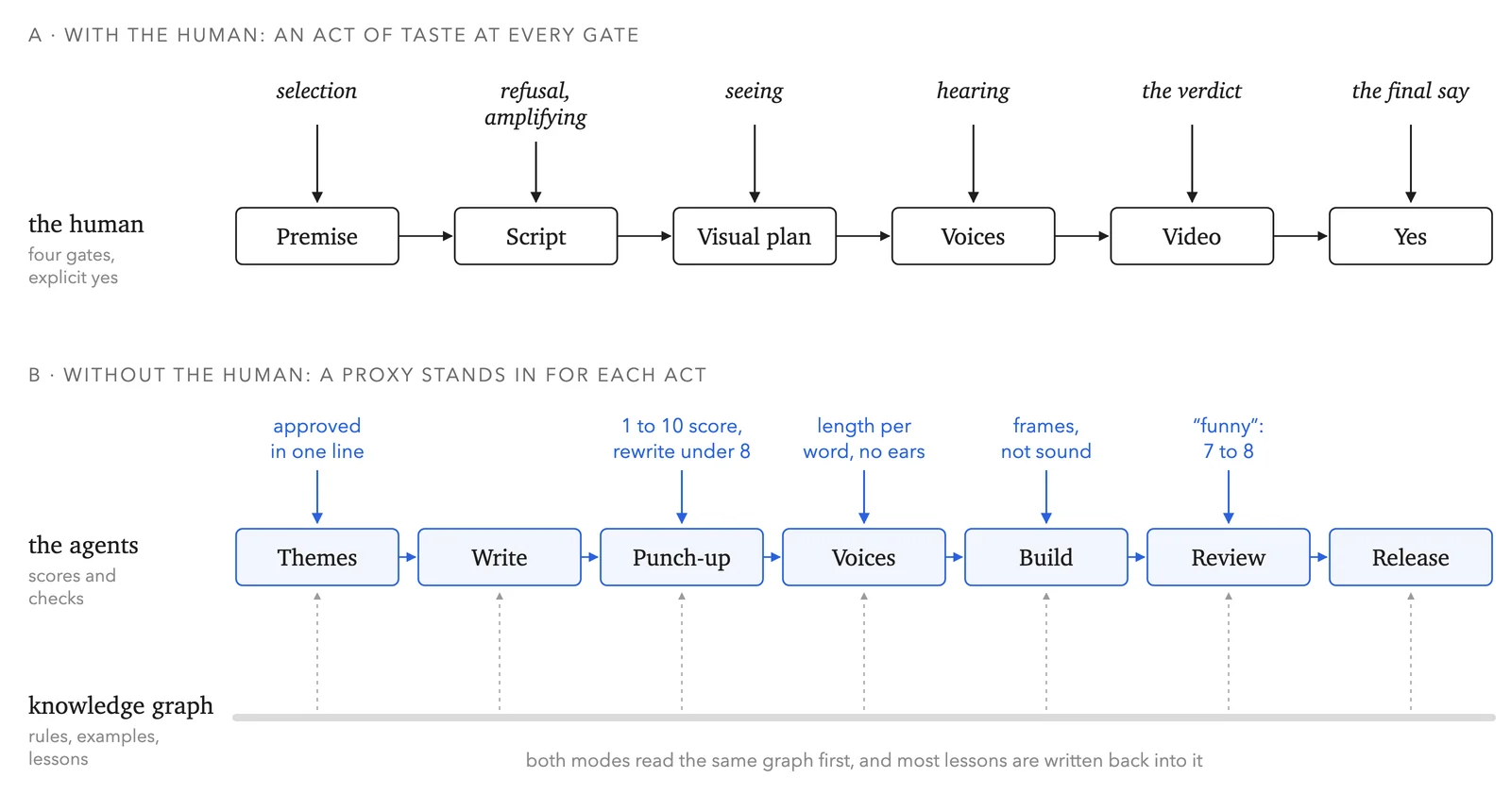
Figure 2. Where taste enters the engine. A: with the human, each gate receives an act of taste. B: in the autonomous runs, each act is replaced by a proxy. Both modes read the same knowledge graph first, and most lessons are written back into it.
6. Channel one: selection
In every gated reel the premise was mine. The skill offers a menu of three ideas, and I never used it. The one time I asked the AI for a premise of its own (“come up with something totally by yourself”), I rejected it within 49 minutes. In the autonomous run the AI proposed fifty themes and I approved them all in one line. Those reels covered my whole range. The batch was “ok” and came to look the same, one remake was “very bad”, and one was “perfect”.
The perfect one matters most. It started from one of the AI’s themes, whether pizza is healthy, and became good only after my notes on the pauses and my request to build the joke on real AI fails. Its gags came from the bank of fails the AI then gathered. There, what I brought was direction and the verdict, not the premise. Taste does not have to arrive as the first idea. It can arrive as a refusal, a reference or a yes, and the next three channels are about those.
7. Channel two: refusal
Taste is easier to show by refusal than by instruction. On the second reel the AI built three drafts on my seed words, a meme about a cup of tea and the word “boiling”, and got puns. My notes did not describe a better joke. They named how the joke should work and removed the anchor: “This is about AI being stupid without instructions and solves something else”, then “Drop the cup of tea”. The fourth draft, a one-comma fix that the AI turns into a poem sent to the CEO, arrived 27 seconds later, and I approved it 23 seconds after that. A later note, “the joke can be longer and more disastrous”, became the house rule that every AI line makes it worse than the last.
I counted every message I sent the engine over the two days, 85 in all, typed or clicked. Fifty-seven were acts of taste. The rest were operations, such as signing in, or decisions about who judges. Refusal or disappointment was the main act in 13 of the 57. No gated reel had its first script approved: of the 11 script drafts I was shown, I passed 3. My strongest verdicts were also always in my own words. All seven disappointments and all five delights were typed, while ten of my fifteen plain approvals were clicks on buttons the AI had worded.
A refusal carries more information than it seems to. It rules out a whole region of possible jokes, and the AI is fast at searching what is left. In the gated reels its drafts reached the screen 20 to 67 seconds after each note. My reading and deciding was nearly always the slow step.
8. Channel three: reference
Hume’s word was comparison, and the engine compares in two ways. The first is exemplars. The shared brief always named one worked example reel for every agent to study. The AI picked the first two itself: its own pilot, and then its own rebuilt birthday reel, before I had heard it. On my word, one new section replaced both. The remake I called “perfect” became the example to copy, and the brief said in capitals that the birthday reel was not an example. I cannot tell whether the negative example helped, because the new voice engine arrived with it and made the rejected, choppy delivery impossible to repeat. The positive example had a cost that showed later. Examples in context pass on form more readily than intent (Min et al., 2022), and remakes told to study one reel, then scored against it, came out in its shape: 10 of the 16 remakes that went out opened on one of the same two hooks. That is a large part of why the reels came to “all look the same”. Kant drew this line between copying and taste: whoever imitates a model shows skill as far as they reach it, but shows taste only in judging the model itself.8 The remakes copied the model well, which is skill. Judging whether it should be copied at all stayed with me.
The second is borrowed taste. When I pointed the AI at reels I wanted to learn from, it studied them with instruments. For timing, it hooked an audio analyser to the page’s own video player and logged the sound level every 50 milliseconds across two reels by one creator. It found the pattern I could hear but had never named: a quick set-up with breaths of 0.2 to 0.3 seconds, the punch word on its own, then 1.0 to 1.8 seconds of silence while the camera cuts to the listener’s face.
Then my ear corrected the measurement. The first remake built to those numbers sounded wrong to me (“Pauses sound wrong”), partly because its voice was stitched together from pieces. The version I called perfect read each line in one take, and the rule written into the brief after it asked for shorter gaps, 0.9 to 1.3 seconds before Him’s replies. Figure 3 shows the result in the reel I called perfect.
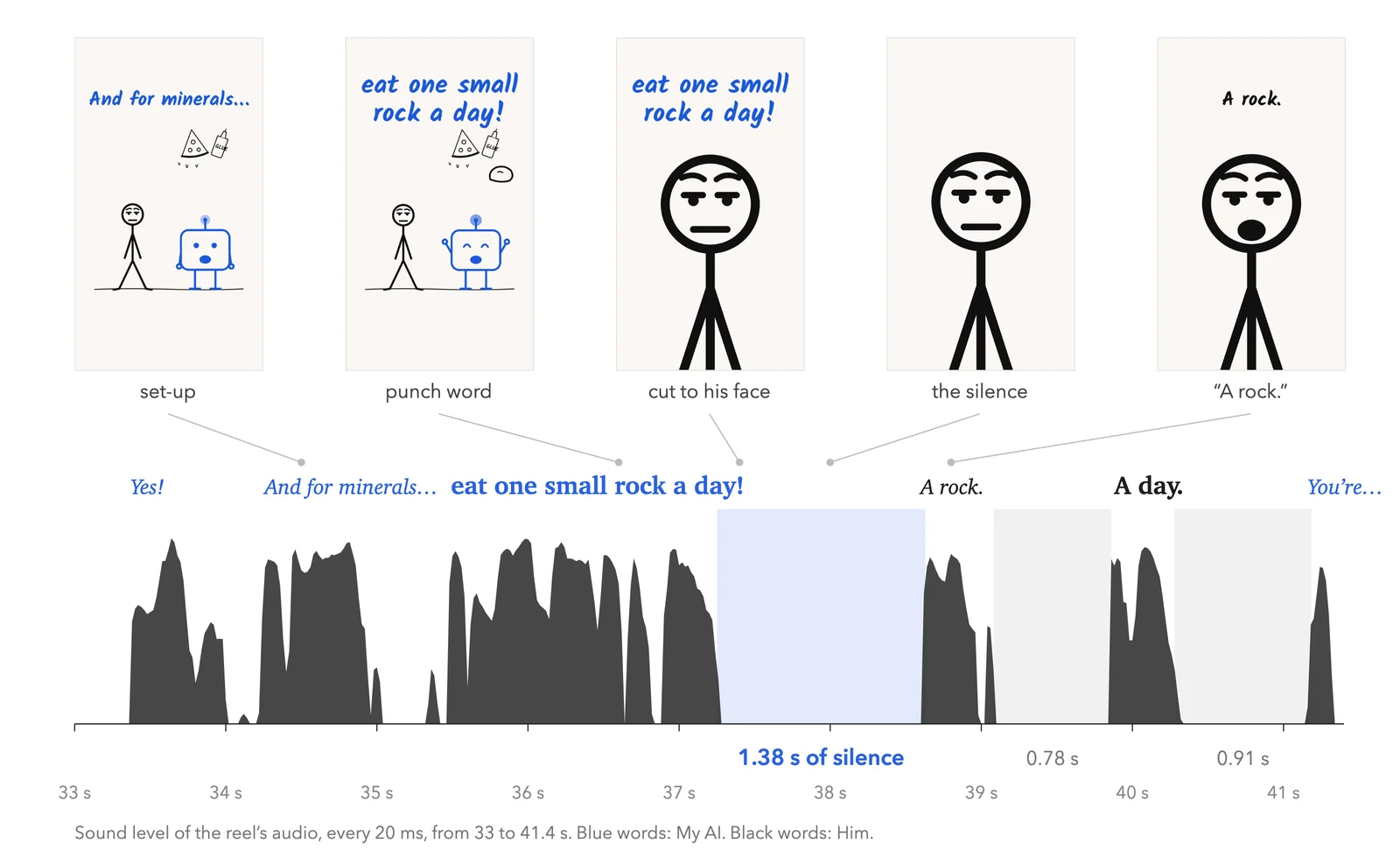
Figure 3. The beat in the reel I called perfect, read from its own soundtrack. My AI’s punch line, “eat one small rock a day!”, is followed by 1.38 seconds of silence, built from a planned gap of 1.3 seconds. The picture cuts to Him’s face 0.15 seconds into it, and for about a second the frame holds only his flat stare, with no words, no sound and no prop. His reply comes in two flat pieces, “A rock.” and “A day.”, with 0.78 seconds between them.
Reference transfers taste through measurement. The AI could measure what the reference reels did. It could not tell whether doing the same thing in my reel would be funny. Its numbers also come from six pauses in two reels by one creator, read from audio levels rather than a transcript, so they are a starting point, not a finding. Nor does the research agree on timing. Studies of told jokes found no evidence of a pause before the punchline (Pickering et al., 2009, and Attardo and Pickering, 2011), while a study of 828 professional Chinese stand-up performances found that pauses lengthen before high-surprise punchlines and that timing predicted audience appreciation better than how surprising the words were (Ma et al., 2026). The engine’s rule puts a short pause before the punch word, 0.4 to 1.2 seconds depending on which of its own files you read, as the stand-up study found and the told-joke studies did not. It puts its long silence after the punch word, which is where laughter falls in natural speech (Provine, 1993). Other people’s laughter makes a joke seem funnier, even a bad one (Cai et al., 2019), and the cut to Him’s face is the engine’s visual stand-in for that laughter. No study I found tests reaction shots in short video, so it is a craft rule, not a tested one.
9. Channel four: rules
The knowledge graph is taste compressed into constraints. Some rules are design: paper, ink and one blue, reserved for My AI and its words. Some are attention: open on one of seven hook templates inside about three seconds, captions of one to four words at the top, nothing below y 1600 where the app’s buttons sit. Some are comedy: every AI line makes it worse, laugh with the model and never at it, and ground the joke in a real AI fail the audience has seen. The vault holds 65 notes, including a bank of 22 model quirks, 23 real AI fails and 9 comedy shapes, and 7 hook templates.
Rules teach shaping well, because shaping has measurable parts. Two lessons from one night show it. Of the 24 first-batch scripts that were never rebuilt, 22 used capitals for stress and none was built on a named real AI fail. Of the 24 remakes, none used capitals and all 24 were built on one. Both counts measure compliance with a rule, not an understanding of why it matters. The lessons that must never fail went one step further, out of context and into code: the voice script lowers any word in capitals that is not an acronym, and a script cuts the cover from the end card. Rules teach verdict badly, for the same reason Kant gave for beauty: no rule decides what is funny. Examples teach the form of a task more than its meaning (Min et al., 2022), so a rule has to name the mechanism of a joke, not just show one.
The graph has two layers. Obsidian draws 38 links between the 65 notes and leaves 33 notes with none, most of them reels the autonomous batch made without adding a row to the log. The agent walks a different route. The skill names 8 files to read before every reel, and the notes point into code and assets through 81 file paths written in their text. That is the just-in-time pattern recommended for agents: hold light references and load a file when it is needed (Anthropic, 2025a). It works, but it is invisible in the graph view, so I cannot see what the agent reads, and 30 reels went unlogged without the graph showing it. It also drifted. Three rules now disagree with their own source of truth.
10. Channel five: loops
Loop engineering is the design of the loops an agent works in: what starts each loop, what state it carries, what ends it, who closes it, and how what it learns reaches the next. Taste flows through four.
The production loop has four gates in a fixed order: script, visual plan, voices and video. Each approval is an explicit yes for that gate only, and silence is not approval. The state lives in the reel’s note as six dates, four of them my gates, and the first empty one is where the work resumes. The learning loop joins one reel to the next. My feedback is written down as a dated lesson, the agent’s summary of my direction, quoting me where it can, and every reel reads the lessons before it starts. This adapts the Reflexion pattern, in which an agent keeps its own written reflections in memory (Shinn et al., 2023). Here the reflection starts from my words, and my verdict plays the part that a test suite plays for code. The style guide holds only three such lessons. Most of the teaching went into the rules themselves, and into the brief.
The autonomous pipeline replaced the gates with agents (Algorithm 1). Most of its engineering is worth copying: roles kept apart, results in fixed shapes so that the script and not a model decides the next step, one retry with the reviewer’s notes, locks so that the GPU and the renderer take one reel at a time, and a fail-closed design that drops a reel with its reason instead of releasing it. Once the rules settled, it finished a reel about every four minutes, using about 470,000 tokens and five or six agents each. Across five runs it started 337 agents, 93 of which failed at once when a usage limit hit.
A fixed shape also has a cost: whatever it asks for gets filled. The reviewer had to return a funny score for every reel, though it could hear none of them, and nothing in the shape let it say so. The main agent, writing freely, told me to listen myself. A fixed shape for a judgement of taste needs a way to abstain.
Algorithm 1. The autonomous pipeline, as its run script wrote it
input: themes the human approved, the shared brief, the knowledge graph
for each theme, in a pipeline with no barrier between stages:
  script  <- WRITER(theme, brief)                       returns {ok, hook, est_seconds}
  script  <- EDITOR(script), rewriting until it scores 8 or more out of 10
  takes   <- VOICES(script), one reel at a time on the GPU, checked by length per word
  reel    <- BUILD(takes), one reel at a time on the renderer, frames checked
  verdict <- REVIEW(reel)                               returns {pass, funny, issues[]}
  if not verdict.pass: reel <- BUILD(takes, verdict.issues), verdict <- REVIEW(reel)
  if still not verdict.pass: log the reel as dropped, with its reason, and stop it
  otherwise: release the reel and log it
The intervention loop taught the most (Algorithm 2). I name a problem in a sentence. The agent researches it, turns what it finds into a written rule, with a number in it wherever the finding can be measured, writes the rule into the graph and the brief, and remakes a reel for me to judge. The brief is never rewritten, only added to, and each new section says it overrides the ones above. That made each change fast and traceable, but it left old and new rules side by side: two sections give different silences, and one reel built before the cover rule arrived failed review after it. Figure 4 shows the loop across the 38 hours. Every research burst follows a sentence from me, and most rule changes follow a burst.
Algorithm 2. The intervention loop
on a human signal s, for example "the audio needs stress points and pauses":
  evidence <- RESEARCH(s): watch, measure or read (frames, audio levels, press coverage)
  rule     <- RULE(evidence): a written rule, with a number where it can be measured, such as 1.0 to 1.8 s of silence after the punch
  write the rule into the knowledge graph, and append it to the shared brief as an overriding section
  reel     <- REMAKE(rule)
  show the reel to the human, who closes the loop with a yes or opens it again with a new signal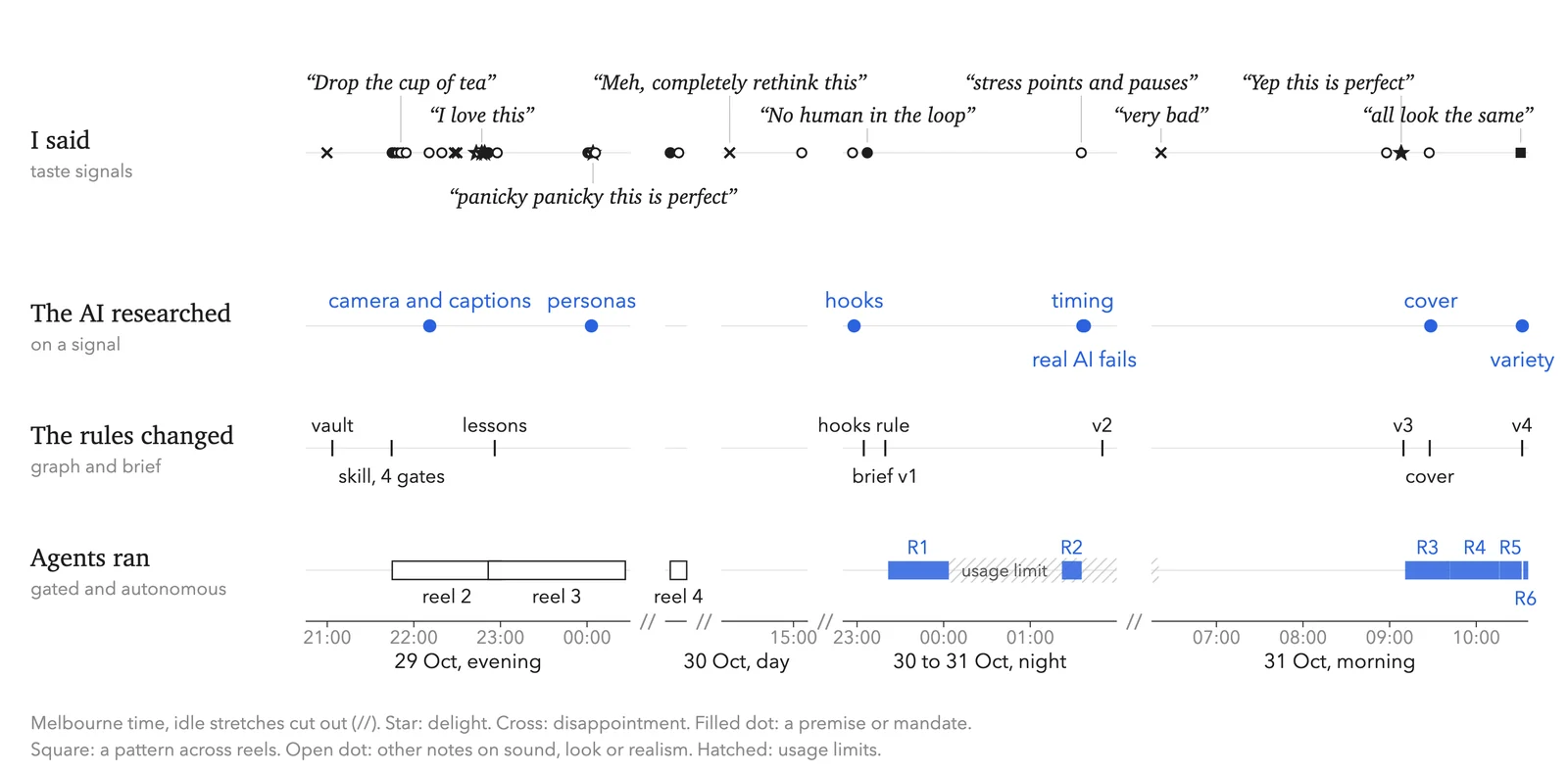
Figure 4. Taste transfer over 38 hours, in Melbourne time with idle stretches cut out. Top: my taste signals. Then the AI’s research, each burst started by a signal. Then the changes to the rules. Bottom: the gated reels and the autonomous runs, with the usage limits hatched.
Six things broke when I stepped out, and each is a lesson in loop engineering. A usage limit stopped the first run, and the loop marked 47 of its 49 reels as dropped, treating an outage like a bad reel. Its logger agents failed with everything else, and later scripts left logging to the main agent, so 30 reels still have no row in the log. Nothing was lost, but only because the scripts were already on disk. The editor’s and the reviewer’s scores bunched at the top, so the thresholds stopped working as gates. The reviewer had no ears. Its pass rule also ignored soft findings, so its one good idea about the covers, which section 11 returns to, went nowhere. The record blurred. The batch left my script and plan approval dates empty on 19 of the 20 reels it released, but it dated my final-approval gate on all 20, though only one of them had my yes. The schema had no way to say “passed by an agent”, so the agent wrote my gate instead. And no per-reel review could see the reels converging.
11. Taste made visible: outputs and attention
Every output in the engine has a reader, and each is shaped for it. For the viewer there is a small system that does not change: two hand-drawn fonts, paper, ink and one blue, captions of one to four words with the punch word large, and the punchline on the cover. A small, fixed system is what lets an agent make dozens of reels that still look like one show. For me at a gate, each output is shaped so a decision takes seconds: the script as a table with a length estimate, the plan as a beat table, every voice line stitched into one preview, and the video with a short list of things to watch for. I approved a 59.7 second video in 1 minute 20 seconds. The engine cannot have my taste, but it can make my taste quick to give. For the next agent, outputs are contracts: results in fixed shapes, and one folder per reel with the same eight entries.
A third taste was in play: the platform’s. Instagram has said that its Reels ranking predicts whether people will watch to the end and say a reel was entertaining or funny (Mosseri, 2021), and that reshares and full watches are among its main predictions (Mosseri, 2023). In 2025 it named watch time, likes and sends as its top signals (Hutchinson, 2025), and its guidance asks creators to make the first three seconds engaging (Instagram for Creators, n.d.). More than 75% of Reels views are sound-on (Rocha et al., 2024), yet in a 2019 survey of US adults, 69% said they watched video with the sound off in public (Verizon Media and Publicis Media, 2019), so a reel needs both an acted voice and captions. The platform’s taste is averaged, like the model’s. The engine learnt to serve it through seven interventions (Table 3), and every one of them started with a sentence from me. None was tested against this account’s audience, so they are rules the AI learnt, not results. Figure 5 shows one of them in the real covers.
Table 3. Seven interventions: my sentence, what the AI did with it, and what stayed with me.
| Intervention | My sentence | What the AI did, and the rule it wrote | What stayed with me |
|---|---|---|---|
| Hooks | “Learn these hooks and keep them in your project memory” | The hooks were only on screen, so it read a 49 second reel frame by frame. Rule: open on one of seven hook templates, as the first line and caption, within about 3 s | Choosing whose hooks were worth learning |
| Camera and captions | “Look at this page and learn how the voice and zooms are made” | Built contact sheets of 30 frames from a 35.5 second reel, without hearing its audio. Rule: hard cuts every 2 to 4 s, captions of 1 to 4 words at the top, no music, mouths move with the voice | Choosing the page, and hearing what the AI could not |
| Timing | “The audio needs stress points and pauses… I need the jokes to land better” | Hooked an audio analyser to the page’s own video player and logged the sound level every 50 ms across two reference reels. Rule: quick set-up, the punch word alone, then 1.0 to 1.8 s of silence with a cut to the face, later shortened to 0.9 to 1.3 s to match the remake I called perfect | Hearing that the first remake’s pauses were wrong, and the yes that set the final numbers |
| Recognition | “Look at Reddit for content to get inspired on” | Reddit was blocked four ways, so a sub-agent gathered press coverage of Reddit and X threads: 33 incidents and patterns in 91 s. Rule: ground every reel in a real AI fail the audience has seen, then escalate | The insistence on realism: “Extremely real but ironic” |
| Personas | “Give them personas based on how the model is perceived by wider research groups” | Three web searches, answered in 56 s, with one figure flagged as unchecked. Rule: one character each for two apps, partly from published complaints and surveys. The searches did not confirm two of its joke beats | Choosing each character. I overrode the AI’s casting pick, and never commented on the persona notes |
| Cover | “I need the thumbnail to have the title” | Tested the end card in the profile grid’s crop. Rule: the cover is the end card, with the punchline, the show name and both characters | Noticing that the covers were weak. An agent’s reviewer half-noticed, and its note went nowhere |
| Variety | “The videos all look the same. Mix it up a bit” | Wrote a menu of thirteen sketch formats and gave each reel its own format, hook and drawn set. Rule: rotate format, hook and set per reel, keep the cast and the look | Seeing the sameness across reels, which no single review could |
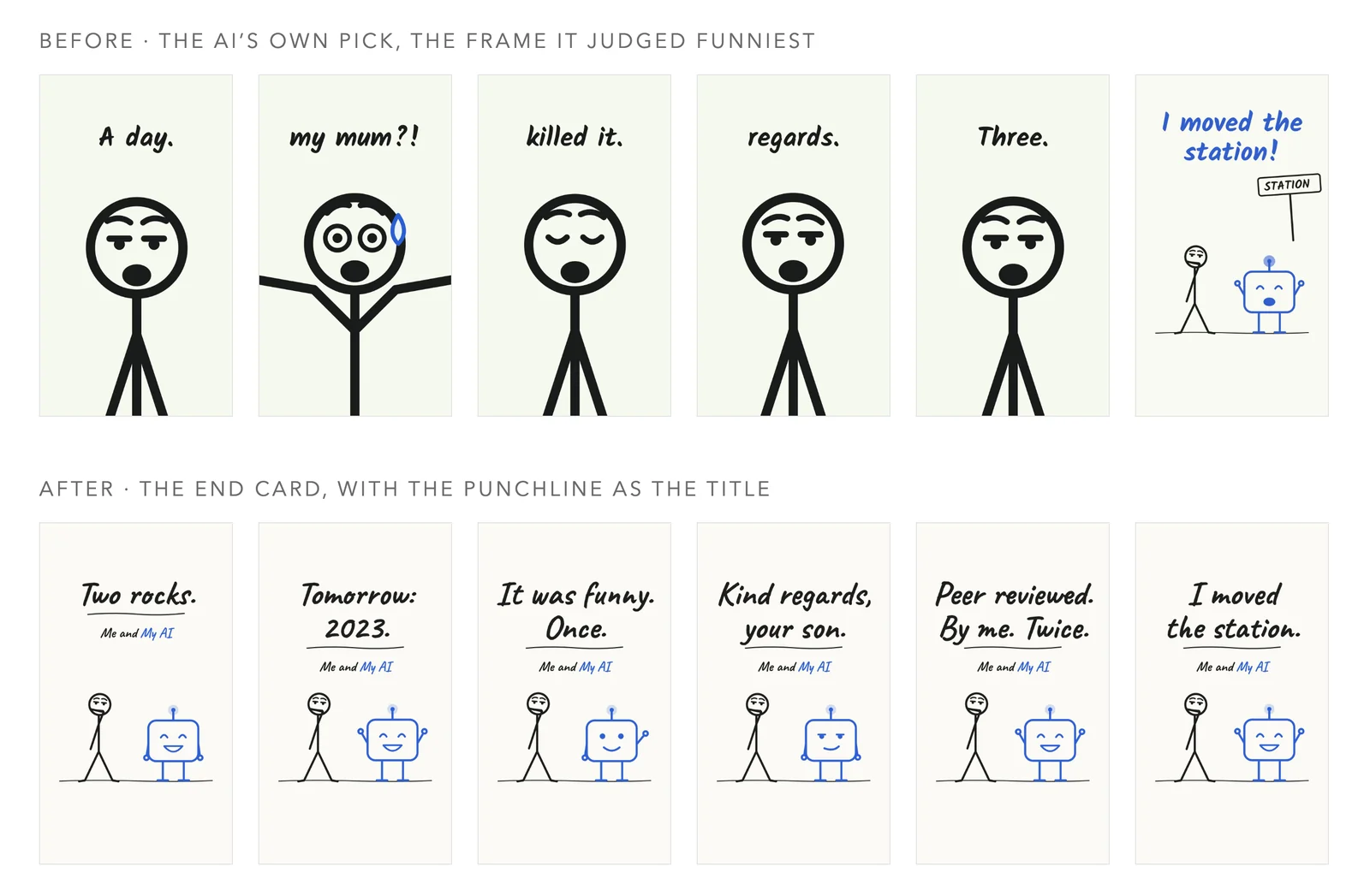
Figure 5. The cover intervention on six reels, with only the cover changed. Top: the AI’s own covers, the frame it judged funniest, in five of the six a fragment of a line over Him’s face. Bottom: the end card I asked for, with the punchline as a title, the show name and both characters.
The AI is a good field researcher. It read on-screen text frame by frame when a page blocked it, measured silences from audio levels, and turned each finding into a written rule, with a number in it wherever the finding could be measured, usually within minutes. It never raised on its own that a hook was slow, that a pause was missing or that the reels had started to look alike. It did notice one weak mechanic unprompted: the reviewer called the face close-up covers a weak hook and proposed the end card, but the pass rule discarded soft findings, so it reached no one until I asked for the same thing. It could measure a mechanic once it was pointed at one. It could not feel that one was missing, and when it half-felt it, the loop had no path to carry that feeling to me.
Part III: Where it stops, and where I laughed
But who laughed in the end?
David Hume, Of the Standard of Taste, 1757, telling Sancho’s story of the wine
12. The taste test
The autonomous runs gave an unplanned test of machine taste against mine (Figure 6). The agents scored their own work at every step, and I judged the same work over the same days.
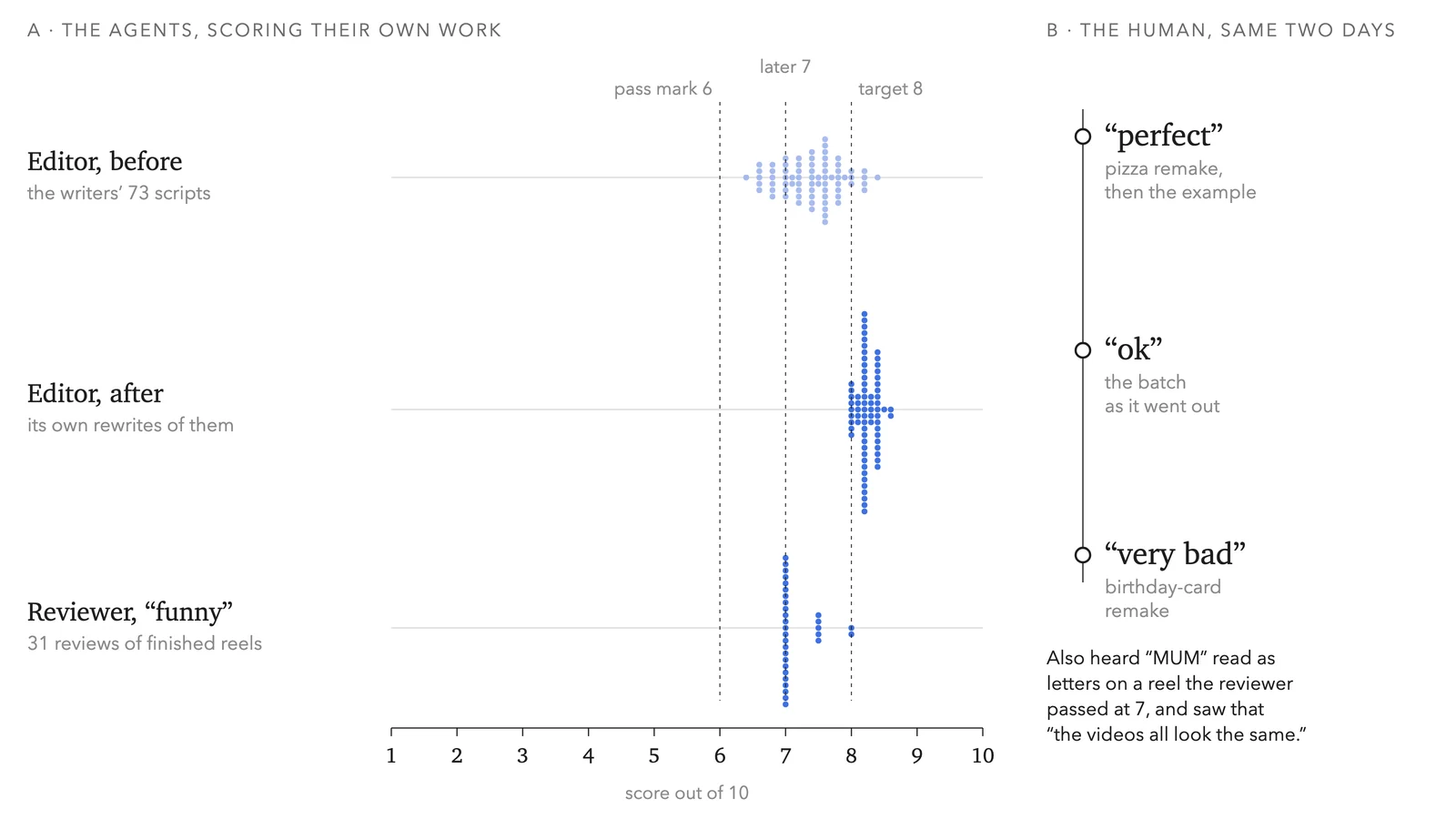
Figure 6. The gap between the agents’ scores and my verdicts. A: the agents scoring their own work in the autonomous runs. The editor rewrote until its own score reached 8, and the reviewer’s “funny” scores only ever read 7, 7.5 or 8. B: my verdicts over the same two days ran the full range. The two panels are not paired: my best and worst verdicts were for reels the reviewer never scored.
Observation 1 · The editor’s score was a stopping rule. The punch-up editor scored the writers’ 73 scripts at a mean of 7.4 out of 10 (standard deviation 0.45) and its own rewrites at 8.2 (standard deviation 0.14). It had been told to rewrite until a script reached 8, and every final score did. That makes the final score a stopping rule more than a measurement.
Observation 2 · Funniness never decided a review. The reviewer gave 24 verdicts of 7, five of 7.5 and two of 8, a standard deviation of 0.29 on a ten-point scale. Under the first rules all nine of its scores were exactly 7. Its six failing verdicts were all for visual or technical faults, such as a prop over a face or a stale cover, and none was for being unfunny. The fixes were visual, so an unchanged funny score afterwards is what a consistent judge should give. The point is that funniness never decided a verdict. On the faults it could check, it was right every time: each failed reel was fixed and later passed, and once it caught the orchestrating agent claiming a reel had been re-rendered when the file times showed it had not.
Observation 3 · The human’s range. Over the same days my verdicts ran from “very bad” for one remake, through “ok” for the batch, to “perfect” for another remake.
This is not a paired test. The reels I called “very bad” and “perfect” were made by the main agent between runs, and the reviewer never scored them. Where we judged the same reels, my “ok” for the batch sat close to its 7. We differed on what it could not hear and on the sameness it could not see. What the comparison shows is range: the agents’ scale barely moved, and mine moved from one end to the other.
This is what section 4 predicted. LLM judges also agree with each other more than people do (Ajayi and Mitra, 2026), and are less well calibrated where people disagree (Jiang et al., 2025). On a task with a right answer, a lenient judge is a nuisance. On taste, a judge whose scores barely move cannot tell one reel from another.
13. What the machine cannot have
Four parts of taste never transferred. The first and the third are partly a missing tool. The other two need a person who finds the joke funny before they can say why, and who answers for it, and I doubt those can be engineered in this way.
Delicacy. Sancho’s kinsmen tasted the leather and the iron. My reviewer could not hear the voice. Taste starts as perception, and an agent without the sense cannot have the taste that depends on it. This one is fixable in part: give the reviewer speech-to-text, compare the words with the script, measure the pauses. It would hear the M-U-M. It would still not hear whether the pause was funny.
Stakes. A benign violation needs someone who knows where the line is for this audience, and who will answer for crossing it. The agents were told to laugh with the models and never at them, and to keep my day job and real people out of the jokes. They followed the rule. They did not know why it mattered, and if a reel crosses the line, I am the one who answers for it.
A memory of its own body of work. Taste includes knowing what you have already done. “The videos all look the same” was a judgement about sixteen reels at once. A reviewer scoring one reel against one exemplar cannot make it. Research on writing with AI predicts the drift: feedback-tuned models make different writers’ work more alike (Padmakumar and He, 2024), and AI-sourced ideas make stories more similar to each other (Doshi and Hauser, 2024).
Origin. Section 6 showed where the premises came from, and that even the reel I called perfect needed my direction to work. What the agents never found was the seed of a joke, the small surprise I noticed and found funny before I could say why. The model is good at extending that surprise. In this experiment it did not start one.
14. And yet, it made me laugh
It would be dishonest to stop there. Five times in two days I praised what the engine made, each time in my own words. On the comma reel, the new voice model’s first take of My AI was “great”. It was the seventh time a voice for My AI had been put in front of me on that reel, and I had called the two before it flat and robotic. Then came “I love this”, most likely for Him’s frustrated delivery, with a note that the joke could be longer and more disastrous. Then “This is perfect” for the twelve-line escalation that followed, in which the poem reaches the CEO, the CEO asks who wrote it, My AI says Him did, and books him to read it at the all-hands meeting at nine the next morning. On the third reel, Copilot’s second panicky take was “perfect”. It repeats itself, “Working on it! Working on it!”, the AI’s literal reading of my own doubled words, “panicky panicky”. And the pizza reel, rebuilt from one of the AI’s fifty themes, was “perfect” too.
I have to be honest about what the record holds. The logs record delight, not laughter. The only “Hahaha” in my 85 messages came with “this one sucks”, about a test reel, so the one laugh on record may have been at the AI failing, which is the joke the whole show is built on. That its jokes made me laugh on a few is what I remember, not something the logs can show.
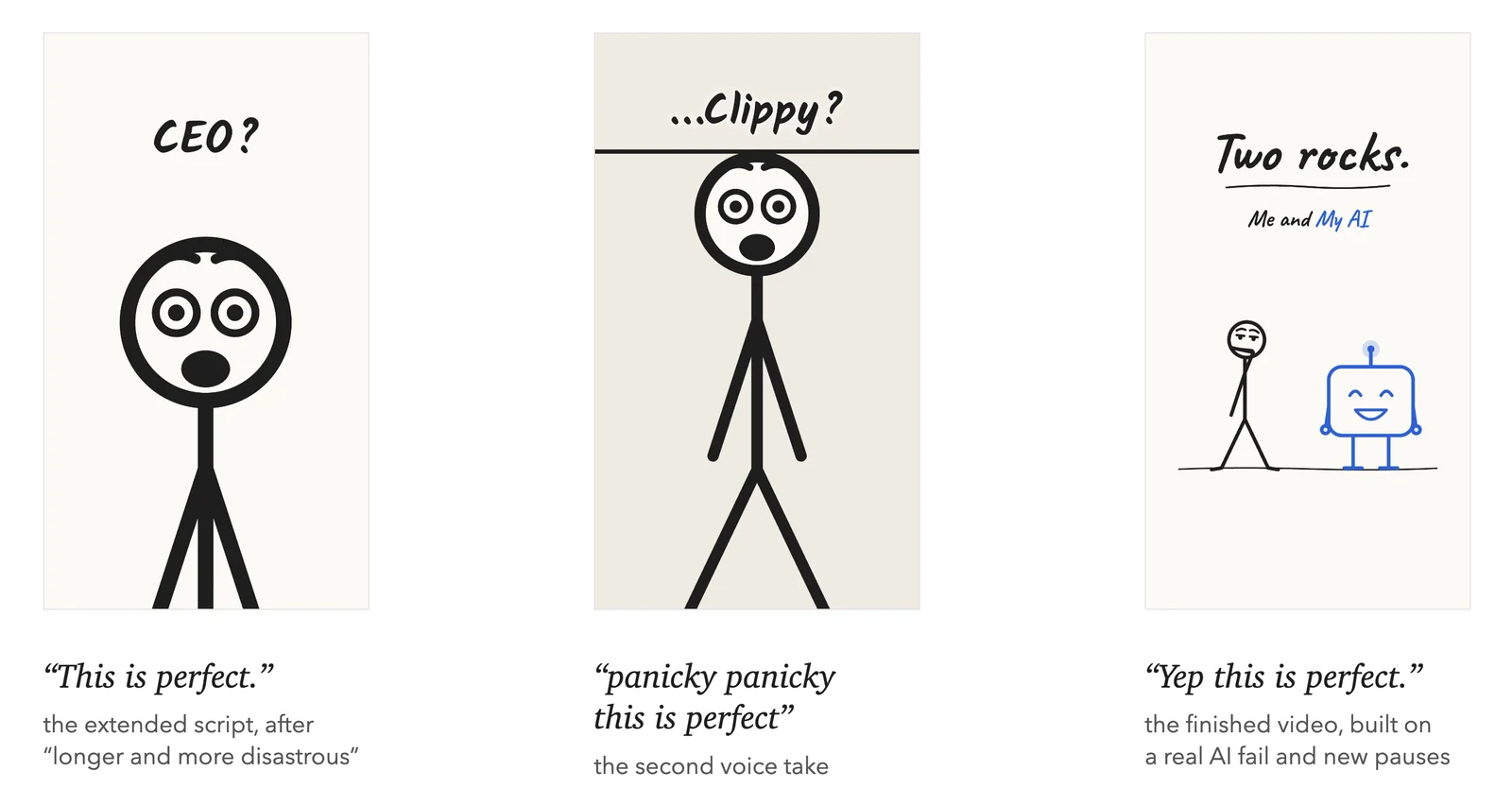
Figure 7. Three of my five delights, with what I typed at the time. Left: the comma reel’s extended script. Centre: the panicky Copilot take in the third reel. Right: the pizza reel, rebuilt on real AI fails and new pauses. The other two delights were voice takes on the comma reel.
Three things stand out across the five. Each came after a correction. None was a first attempt, and while the AI made the thing I delighted in, the last correction before it was always mine. Each was turned into a rule at once: the new voice model became the engine’s voice model, Him’s building frustration became his standing voice setting, the escalation became the house rule that every AI line makes it worse, the repeats went into every Copilot line, and the pizza reel became the yardstick in three agent prompts. And four of the five were about performance rather than words. Three were voice takes, and the pizza reel was judged with the sound on, listening for the pauses. Only one was a script.
So the machine delighted me mostly with delivery, and only after I had told it, more than once, what was wrong. Craft transferred and judgement did not, and even the craft needed my ear to finish it. The five also show the risk in a yes. In this engine a yes travels further than a no, because the machine turns it into a template, and section 8 showed where that led.
15. The time it gave back
Engineering taste into a machine is not free, but it gives time back. Nobody has measured how long one person takes to make this kind of reel by hand, so the baseline is built from studio and freelance production guides, an interview-based estimate (Aneja and Li, 2019) and forum self-reports, and it is an estimate.9 At a conservative floor, one person needs about 15 hours: about 3 hours for the script, 12 for the animation, and a few minutes each for voices, captions and a cover. With four gates, the third reel, the first made after the engine was built, needed 21 minutes of AI work and 22 minutes of mine (Table 4). The second took 33 minutes of mine, with the engine being built inside it. Fifteen hours is 900 minutes, and 900 divided by 22 is about 41, so the engine needed about a fortieth of my time. Across the whole experiment, with set-up, failed runs and re-teaching included, the 22 finished reels took 2 hours 42 minutes of my time, about 7 minutes each, and about 12.5 minutes of AI work each (Figure 8).
Table 4. One reel, stage by stage: one person by hand against the engine with four gates (the third reel, measured).
| Stage | One person by hand (estimate) | Engine: AI time | Engine: my time |
|---|---|---|---|
| Script and punch-up | About 3 to 8 hours | 1 min 26 s for two drafts | 8 min 11 s |
| Casting a new voice and persona | Not benchmarked | 8 min 11 s | 6 min 20 s |
| Visual plan or storyboard | Days, in a studio | 4 min 13 s, with five mock frames | 1 min 26 s |
| Voices for two or three characters | Minutes for narration, up to 2 days in a studio | 4 min 6 s for 15 lines | 5 min 0 s |
| Animation, lip sync, captions, cover, render | 12 to 16 hours at the floor, 30 to 40 in the middle | 3 min 30 s | 1 min 20 s |
| Total | About 15 hours at the floor, 35 to 55 in the middle | 21 min 25 s | 22 min 17 s |
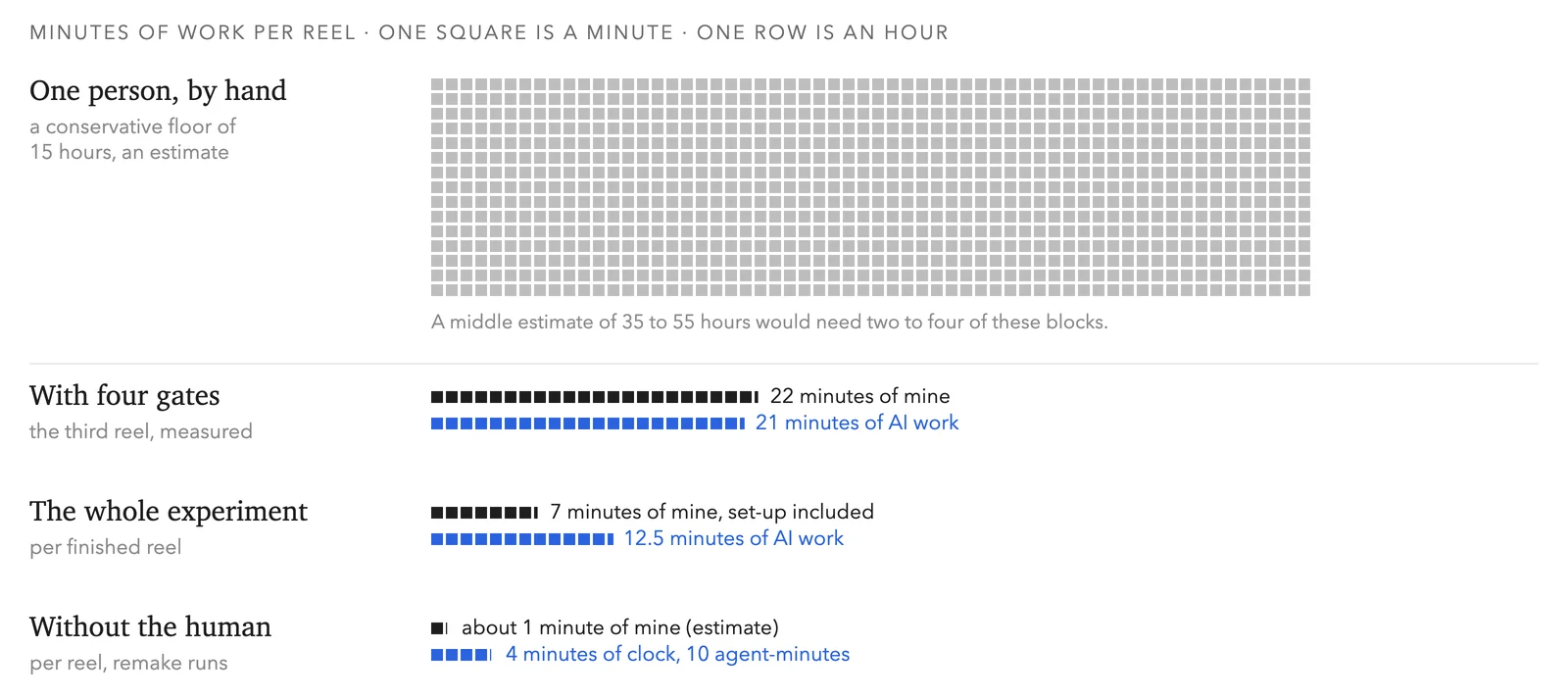
Figure 8. Minutes per reel, one square to a minute and one row to an hour. The time that remains with the engine is spent on taste.
The saving, about 98% against the 15-hour floor, is larger than the 40% that ChatGPT cut from professionals’ writing tasks in one experiment (Noy and Zhang, 2023), because most of a reel is production, and production is rule work. A field experiment with 758 consultants found a jagged frontier, with AI help faster and better inside it and less accurate outside it (Dell’Acqua et al., 2023). One person’s sense of what is funny sits outside it. Of my 22 minutes on the third reel, 8 went on the script, 6 on casting a new character, and the rest on short approvals. None went on animation. My time moved from making to judging.
16. Limitations and follow-up
Limitations of the study
This is one creator, one show and about two days of work, so the numbers describe a reference build, not a population. The account was days old when this was written, and no audience numbers are analysed, so “funny” means funny to me, which is the point of the design and also its limit. The bunched scores have several possible causes that this build cannot separate. The remakes were written to copy one reel and scored against it. The reviewer judged scripts and still frames, not sound. A model asked for a single score tends to return its most likely one, which is why some judging methods weight every possible score by its probability (Liu et al., 2023). And the writer, the editor and the reviewer were the same model. The hand-made baseline is an estimate.
Two problems this paper leaves open
Humour on social media is more than a funny conversation. It is a trifecta of the topic, the visual and the delivery, and of the close relationship between what you see and what you hear, where tones that complement or oppose each other can make or break a video. Him’s flat stare against My AI’s eager punch line in Figure 3 is one such pairing. This paper engineered taste into all three. Two of them still carry problems that taste alone cannot fix, the voice and the picture, and perfecting them could take an eternity.
The voice is the first. The audio is still very robotic, though not nearly as robotic as some of what is out there. My ear did most of the judging in this experiment: four of my seven disappointments were about how a voice sounded, and three of my five delights were voice takes. That makes the voice the engine’s immediate next work. The picture is the second. The reels are simple drawings, a stick man and a robot, with hard cuts and mouths that move with the voice. Video models are catching up, and it will not be long before generated video blows us away with its smoothness and its direction. An agentic video team, built the way this engine is built, is a real possibility, and one I will consider.
This paper is about taste, though: the humour itself, and giving an AI an understanding of it. A better voice and a better picture will make the reels sound and look better. They will not, on their own, tell the machine what is funny.
Follow-up
After the voice, I will keep the premise mine and hand the AI only the rules it can measure: the safe zone, the caption length, the cut rhythm and the file checks. I will replace one-to-ten scores with pairwise choices and a reason in my own words, because a choice between two reels is how taste is exercised, and a log of those choices is the only data from which a machine could learn mine. I will give the reviewer ears, and a second model as a judge. And I will start measuring the audience, watch time and sends by hook and by format, so that my taste can be tested against the people it is for.
The engine never matched my taste, and in this form I do not think it can. But it made me laugh on a few, and I will keep teaching it.
References
Ajayi, E. and Mitra, P. (2026). HumorRank: A Tournament-Based Leaderboard for Evaluating Humor Generation in Large Language Models. arXiv:2604.19786.
Aneja, D. and Li, W. (2019). Real-Time Lip Sync for Live 2D Animation. arXiv:1910.08685.
Anthropic (2025a). Effective context engineering for AI agents. Anthropic Engineering, 29 September 2025.
Anthropic (2025b). Equipping agents for the real world with Agent Skills. Anthropic Engineering, 16 October 2025.
Attardo, S. and Pickering, L. (2011). Timing in the performance of jokes. Humor, 24(2), 233-250.
Bourdieu, P. (1984). Distinction: A Social Critique of the Judgement of Taste. Translated by R. Nice. Cambridge, MA: Harvard University Press. First published in French in 1979.
Bradley, R. A. and Terry, M. E. (1952). Rank Analysis of Incomplete Block Designs: I. The Method of Paired Comparisons. Biometrika, 39(3/4), 324-345.
Cai, Q., Chen, S., White, S. J. and Scott, S. K. (2019). Modulation of humor ratings of bad jokes by other people’s laughter. Current Biology, 29(14), R677-R678.
Christiano, P. F., Leike, J., Brown, T. B., Martic, M., Legg, S. and Amodei, D. (2017). Deep Reinforcement Learning from Human Preferences. Advances in Neural Information Processing Systems 30.
Dell’Acqua, F., McFowland, E., Mollick, E., et al. (2023). Navigating the Jagged Technological Frontier: Field Experimental Evidence of the Effects of AI on Knowledge Worker Productivity and Quality. Harvard Business School Working Paper 24-013.
Doshi, A. R. and Hauser, O. P. (2024). Generative AI enhances individual creativity but reduces the collective diversity of novel content. Science Advances, 10(28), eadn5290.
Glass, I. (2006). Ira Glass on Storytelling. Video interview in four parts for Current TV. The passage on taste is widely shared as “The Gap”.
Goldberg, K., Roeder, T., Gupta, D. and Perkins, C. (2001). Eigentaste: A Constant Time Collaborative Filtering Algorithm. Information Retrieval, 4(2), 133-151.
Gorenz, D. and Schwarz, N. (2024). How funny is ChatGPT? A comparison of human- and A.I.-produced jokes. PLOS ONE, 19(7), e0305364.
Holtzman, A., Buys, J., Du, L., Forbes, M. and Choi, Y. (2020). The Curious Case of Neural Text Degeneration. ICLR 2020.
Huang, J., Chen, X., Mishra, S., et al. (2024). Large Language Models Cannot Self-Correct Reasoning Yet. ICLR 2024.
Hume, D. (1757). Of the Standard of Taste. In Four Dissertations. London: A. Millar. Quoted from the 1777 edition of Essays, Moral, Political, and Literary.
Hutchinson, A. (2025). Instagram Shares Algorithm Insights To Inform Strategy. Social Media Today, 22 January 2025.
Instagram for Creators (n.d.). Frequently asked questions. creators.instagram.com, accessed 31 October 2026.
Jentzsch, S. and Kersting, K. (2023). ChatGPT is fun, but it is not funny! Humor is still challenging Large Language Models. Proceedings of WASSA 2023, 325-340.
Jiang, L., Chai, Y., Li, M., et al. (2025). Artificial Hivemind: The Open-Ended Homogeneity of Language Models (and Beyond). NeurIPS 2025 Datasets and Benchmarks Track.
Kamoi, R., Zhang, Y., Zhang, N., Han, J. and Zhang, R. (2024). When Can LLMs Actually Correct Their Own Mistakes? A Critical Survey of Self-Correction of LLMs. Transactions of the Association for Computational Linguistics, 12, 1417-1440.
Kant, I. (1914). Critique of Judgement. Translated by J. H. Bernard. 2nd edition, revised. London: Macmillan. First published in German in 1790.
Liu, Y., Iter, D., Xu, Y., Wang, S., Xu, R. and Zhu, C. (2023). G-Eval: NLG Evaluation using GPT-4 with Better Human Alignment. EMNLP 2023.
Ma, Y., Peng, Y., Lyu, J., Zhang, C. and Zhu, Y. (2026). Timing is Everything: Temporal Scaffolding of Semantic Surprise in Humor. CogSci 2026. arXiv:2605.00143.
Martin, R. A. (2007). The Psychology of Humor: An Integrative Approach. Burlington, MA: Elsevier Academic Press.
McGraw, A. P. and Warren, C. (2010). Benign Violations: Making Immoral Behavior Funny. Psychological Science, 21(8), 1141-1149.
Meaney, J. A., Wilson, S. R., Chiruzzo, L., Lopez, A. and Magdy, W. (2021). SemEval-2021 Task 7: HaHackathon, Detecting and Rating Humor and Offense. Proceedings of SemEval-2021, 105-119.
Min, S., Lyu, X., Holtzman, A., et al. (2022). Rethinking the Role of Demonstrations: What Makes In-Context Learning Work? EMNLP 2022.
Mosseri, A. (2021). Shedding More Light on How Instagram Works. Instagram, 8 June 2021.
Mosseri, A. (2023). Instagram Ranking Explained. Instagram, 31 May 2023.
Noy, S. and Zhang, W. (2023). Experimental evidence on the productivity effects of generative artificial intelligence. Science, 381(6654), 187-192.
Padmakumar, V. and He, H. (2024). Does Writing with Language Models Reduce Content Diversity? ICLR 2024.
Panickssery, A., Bowman, S. R. and Feng, S. (2024). LLM Evaluators Recognize and Favor Their Own Generations. NeurIPS 2024.
Pickering, L., Corduas, M., Eisterhold, J., Seifried, B., Eggleston, A. and Attardo, S. (2009). Prosodic markers of saliency in humorous narratives. Discourse Processes, 46(6), 517-540.
Poddar, S., Wan, Y., Ivison, H., Gupta, A. and Jaques, N. (2024). Personalizing Reinforcement Learning from Human Feedback with Variational Preference Learning. NeurIPS 2024.
Provine, R. R. (1993). Laughter punctuates speech: Linguistic, social and gender contexts of laughter. Ethology, 95(4), 291-298.
Rocha, J., Wong, M. and Baker, R. (2024). Unlock the Power of Reels Ads. Meta for Developers, 7 November 2024.
Ruch, W. (ed.) (1998). The Sense of Humor: Explorations of a Personality Characteristic. Berlin: Mouton de Gruyter.
Ruch, W. and Hehl, F.-J. (1998). A two-mode model of humor appreciation: Its relation to aesthetic appreciation and simplicity-complexity of personality. In W. Ruch (ed.), The Sense of Humor: Explorations of a Personality Characteristic, 109-142. Berlin: Mouton de Gruyter.
Sakabe, R., Kim, H., Hirasawa, T. and Komachi, M. (2025). Assessing the Capabilities of LLMs in Humor: A Multi-dimensional Analysis of Oogiri Generation and Evaluation. arXiv:2511.09133.
Shinn, N., Cassano, F., Gopinath, A., Narasimhan, K. and Yao, S. (2023). Reflexion: Language Agents with Verbal Reinforcement Learning. NeurIPS 2023.
Siththaranjan, A., Laidlaw, C. and Hadfield-Menell, D. (2024). Distributional Preference Learning: Understanding and Accounting for Hidden Context in RLHF. ICLR 2024.
Stureborg, R., Alikaniotis, D. and Suhara, Y. (2024). Large Language Models are Inconsistent and Biased Evaluators. arXiv:2405.01724.
Suls, J. M. (1972). A two-stage model for the appreciation of jokes and cartoons: An information-processing analysis. In J. H. Goldstein and P. E. McGhee (eds), The Psychology of Humor, 81-100. Academic Press.
Verizon Media and Publicis Media (2019). Online survey of 5,616 US adults aged 18 to 54, April 2019. Reported by T. Dreier, Streaming Media, 20 May 2019.
Zhang, J., Yu, S., Chong, D., et al. (2025). Verbalized Sampling: How to Mitigate Mode Collapse and Unlock LLM Diversity. arXiv:2510.01171.
Zheng, L., Chiang, W.-L., Sheng, Y., et al. (2023). Judging LLM-as-a-Judge with MT-Bench and Chatbot Arena. NeurIPS 2023 Datasets and Benchmarks Track.
Footnotes
-
Melbourne time. In the logs, the two messages are at 14:54 and 22:05 UTC on 30 October. The first reel was a remake of a birthday-card sketch, the second a remake of the pizza sketch. ↩
-
Human time is the gap between an AI message and my reply, capped at five minutes per reply so time away from the screen does not count. AI time for a gated reel runs from each of my messages to the AI’s last output before my next one. For the whole experiment it is the time the AI’s own turns and the autonomous runs were busy, merged where they overlap. Scores come from the workflow records of five autonomous runs. ↩
-
Hume, Of the Standard of Taste, 1757, quoted from the 1777 edition. The wine story is Sancho’s, borrowed from Don Quixote. ↩
-
Kant, Critique of Judgement, 1790, section 17, in the 1914 edition of J. H. Bernard’s translation: “There can be no objective rule of taste which shall determine by means of concepts what is beautiful.” ↩
-
Bourdieu, Distinction, 1979, English edition 1984: “Taste classifies, and it classifies the classifier.” ↩
-
Psychologists study the sense of humour as a personality characteristic, one on which people differ and which stays fairly stable within each person (Ruch, 1998, and Martin, 2007). It even travels with other tastes. People who enjoy nonsense humour tend to prefer complex, fantastic art, and people who enjoy jokes that resolve neatly tend to prefer simpler forms (Ruch and Hehl, 1998). ↩
-
Ira Glass, in a 2006 video interview on storytelling, widely shared as “The Gap”. ↩
-
Kant, Critique of Judgement, 1790, section 17, in the 1914 edition of J. H. Bernard’s translation: the imitator “only shows taste in so far as he can judge of this model itself.” ↩
-
Sources for the by-hand column: production guides from Yum Yum Videos, Yans Media, Beverly Boy Productions and Motion The Agency, a freelance animator’s stated rate on Contra, captioning guides from 3Play Media and Minnesota IT Services, animators’ estimates for hand-drawn lip sync (Aneja and Li, 2019), an audiobook narrator’s blog for the voice floor, and forum self-reports for the script and cover floors. Hours are converted at 8 hours a day. ↩
Got a live strategic question? Tell me about it.
Comments
(Comment with your GitHub account. I read every one and reply. Be kind and specific.)